Chips took the index down with them, and the VIX noticed
Published Nov 16, 2026, 1:50 PM PT. Figures and prices are as of that date; the current record is at /results.

Prices as of 1:46 PM Pacific today, Monday, all official closes. Coil Engine beta figures for today stay preliminary until tonight's settle.
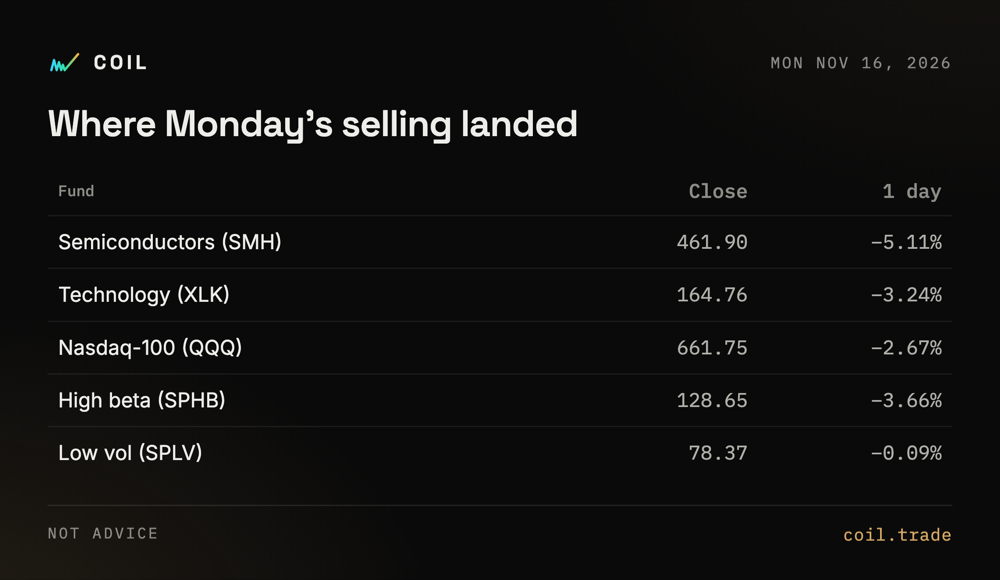
Monday was a semiconductor day that happened to land on an index. SMH closed −5.11%, QQQ −2.67% and SPY −1.91%, and the VIX jumped +18.70% to 22.91. The weak spot is Nvidia, whose chief executive resigned last week and whose next report now sits over every AI name. We think the Nasdaq-100 stays heavy through the week, and the book finished the day in cash.
Nvidia without its founder, and the sector that trades on it
Nvidia said in a filing last Thursday that Jensen Huang had stepped down as president, chief executive and director, with the finance chief running the company on an interim basis while the board searches. Today the sector did the paying. SMH is −17.49% from its 50-day, which is a long way for a fund that size, and SPHB, the high-beta fund, closed −3.66% on the day.
Nobody needed a fresh headline for this. A group that had been bounced hard for a week met a report that is now a referendum on whether the company works without the person who built it. Traders sold the risk before the number rather than after it. That is what a ten-minute look at the tape says, and we cannot see the order flow behind it.
The index fell harder than the equal-weight version
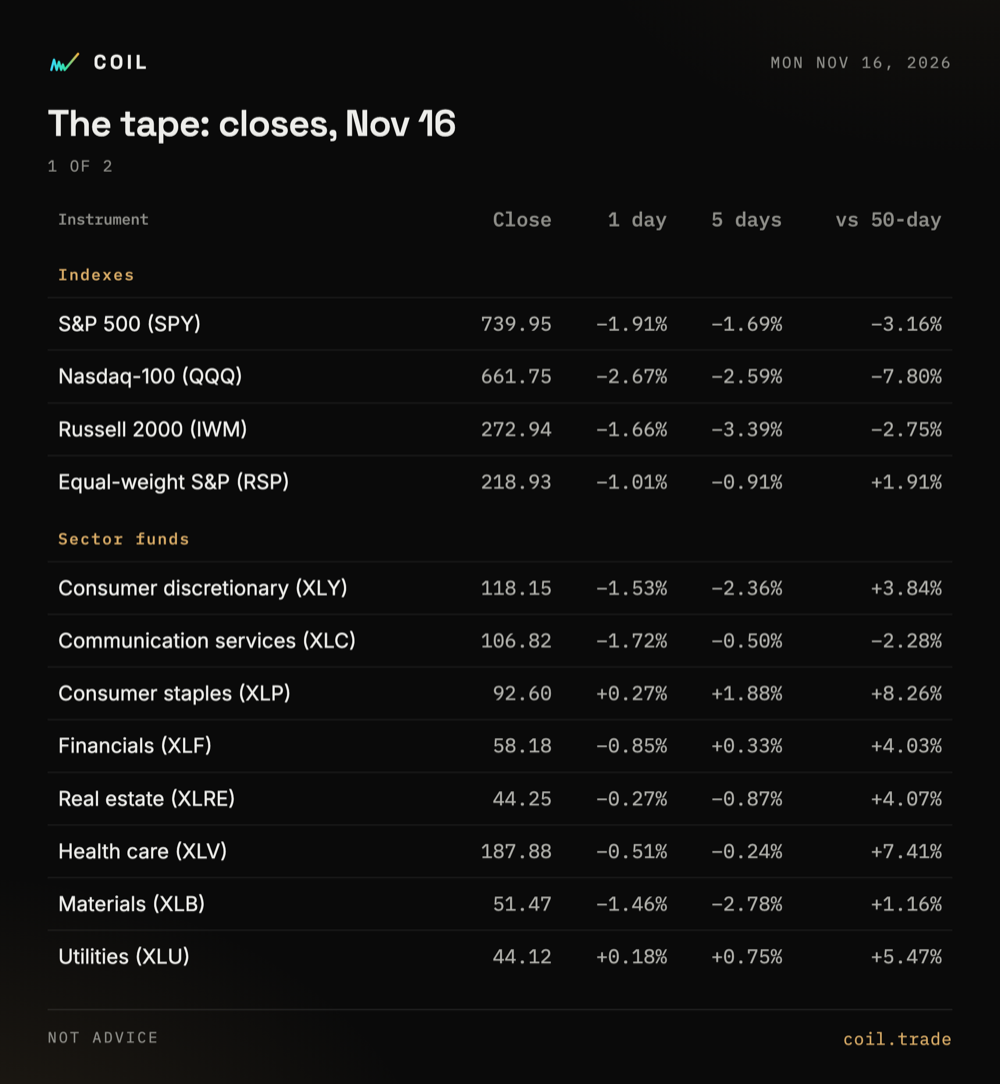
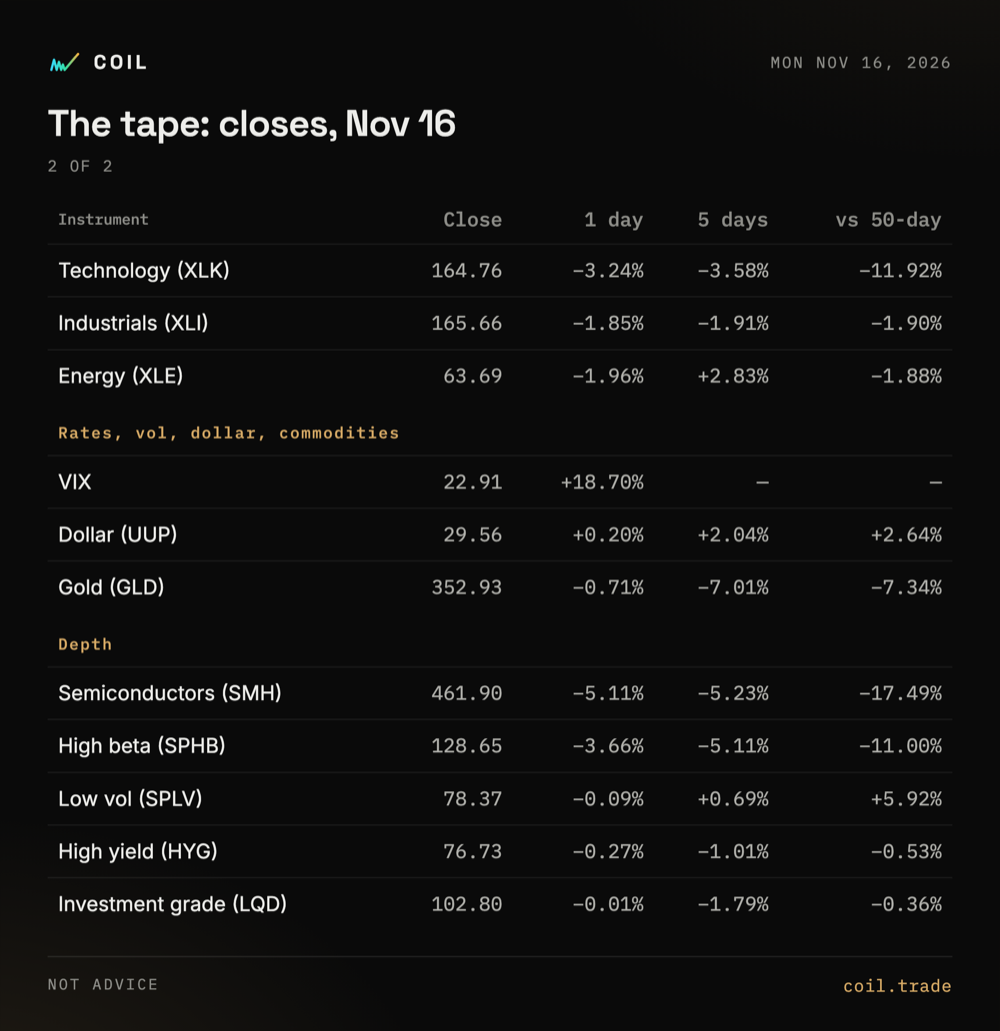
SPY lost −1.91% and RSP, the equal-weight S&P, lost −1.01%. That gap is the whole story of a megacap tape: the average stock had a bad day and the heavy names had a worse one. Staples and utilities closed green, with XLP at +0.27% and XLU at +0.18%, and XLK was the worst sector fund by a wide margin at −3.24%.
Credit did not panic. HYG gave back −0.27% and LQD was flat at −0.01%, so this was equity risk being cut and not funding stress. Gold fell −0.71% and −7.01% on the week while the dollar fund rose +2.04%, which is the usual shape when everyone wants cash and nothing else. QQQ sits −7.80% from its 50-day. SPY is −3.16% from its own.
The book: a day of cuts
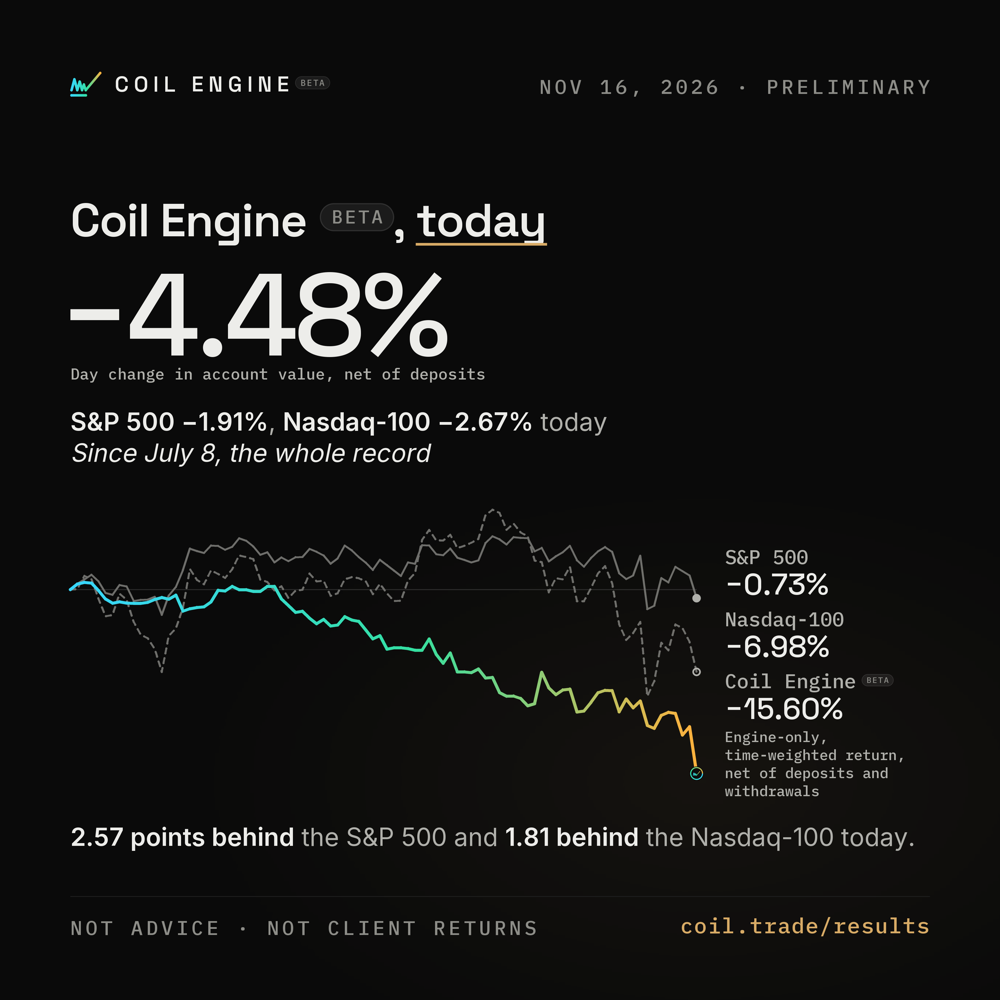
Coil Engine beta, Monday Nov 16: −4.48%. S&P 500 (SPY): −1.91%. Nasdaq-100 (QQQ): −2.67%. Today's figure is preliminary until tonight's settle.
Since July 8, 2026, through Nov 13: Coil Engine beta −11.64%, SPY +1.20%, QQQ −4.43%. Engine-only, time-weighted return, net of deposits. Two down sessions held flat and one hand-placed trade removed: see /results.
We closed out of everything today, and 10 of 12 of those exits were losses. SH came out at +0.67% and PSQ at +0.06%, the only two green closes, and they are the funds that profit when the index drops, so they did what they were bought to do and it was small. The damage sat in the chip-linked names: SKHY at -6.01%, STX at -4.75%, GLW at -4.49% and DELL at -4.12%.
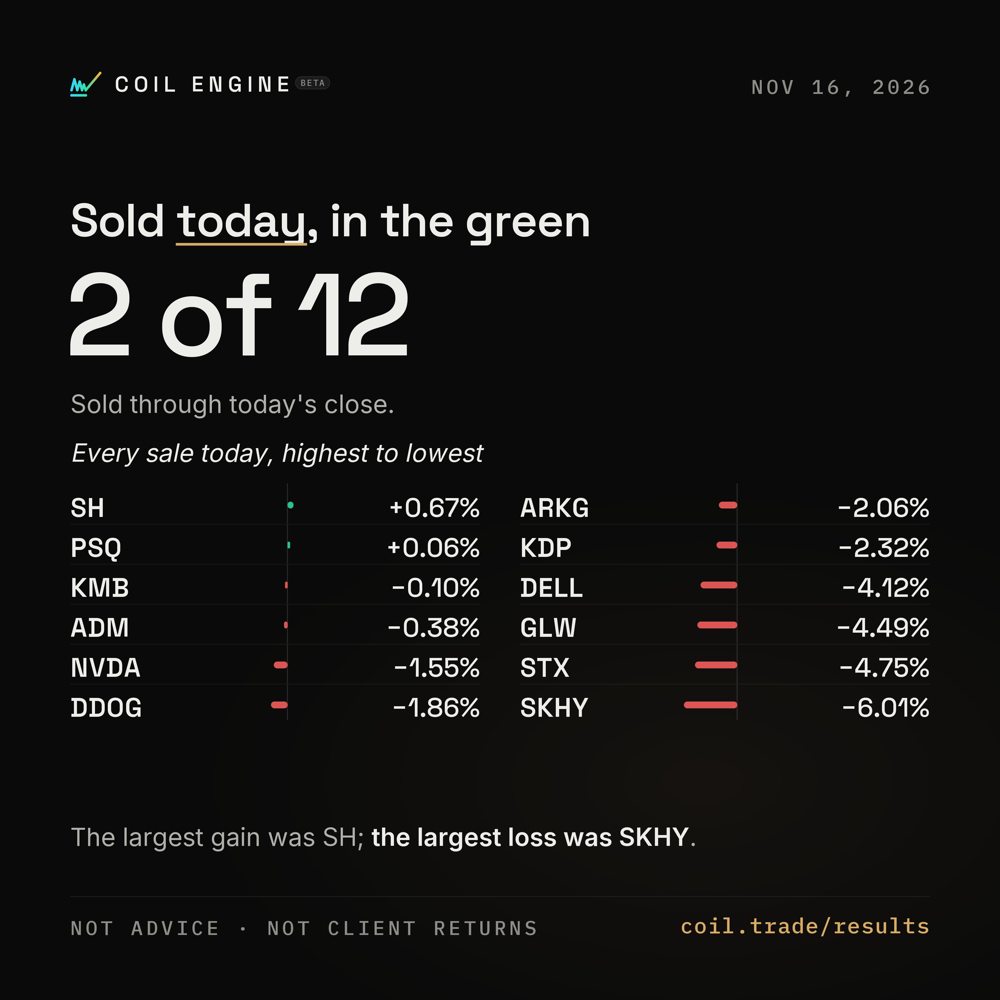
We carry nothing tonight, and the whole account is cash.
The mistake is plain enough. We owned a basket of names that trade as one bet on AI hardware into a week with Nvidia's report in it, with both indexes already weak. We did not need a view on the resignation to see that the tape was fragile, and the exits on those chip names are where the day cost us.
The call
Consensus today reads the selloff as a pre-earnings trim in a trend that is otherwise intact, with the chips to recover once Nvidia's number is out. We see it a little differently, because SPY is only −3.16% from its 50-day while QQQ is well under its 200-day and −7.80% from its 50-day, so the index that carries the AI trade is already in a downtrend before the report arrives. A good Nvidia print can lift the chips, and it does less for an index that has to get back over two moving averages first.
We think QQQ closes below Monday's close of 661.75 on Friday, November 20.
What would prove us wrong: A QQQ close above Monday's close on Friday, November 20.
Two risks to it, as strongly as the other side would put them. A clean Nvidia report with a credible succession plan could squeeze the shorts and put QQQ back through Monday's close in a day. And a market that has just had a sharp jump in the VIX often has its worst day behind it, since forced sellers are done once they are done.
Both indexes are weak. The S&P 500 fund is a pullback inside a longer uptrend, still above its 200-day but under its 55-day and still falling. The Nasdaq-100 fund is plainer: it is under its 200-day, and that is a downtrend. Money already sits in staples, health care, utilities and the dividend payers, and it has left technology, the miners and the metals complex. That agrees with the common read on the defensive rotation and disagrees with it on how much of the dip is a buying chance.
The book is all cash tonight, though we got there after taking losses on the way. The picture improves when the S&P 500 fund stops falling and climbs back over its 55-day, and when the Nasdaq-100 fund gets back above its 200-day. We are watching those two lines.
The gate, the sector map and the list of names at an entry are the reads an AI agent gets when it connects to Coil over the Model Context Protocol, or one paid read at a time over x402, and the free ones need no key: coil.trade/connect.
Keep reading
When a single stock drags a whole index, it helps to know how to tell a sector selloff from a market selloff, and that is laid out in plain terms at coil.trade/learn.
Our full record is at coil.trade/results.
Not advice.
COIL CLOSE is impersonal market commentary. It states a dated view of a market instrument, graded against its stated test, and is not investment advice, a recommendation or an instruction to trade, and is not tailored to anyone’s circumstances. Figures and prices are as of the time stated above.