Nvidia lost its CEO and the index shrugged
Published Nov 12, 2026, 2:10 PM PT. Figures and prices are as of that date; the current record is at /results.

Prices as of 2:08 PM Pacific today, Thursday, all official closes. Coil Engine figures stay preliminary until tonight's settle.
Nvidia lost its chief executive on Thursday, and the index barely moved. Jensen Huang resigned with immediate effect, the stock closed −4.34%, and the S&P 500 closed −0.35%. Money left one name and stayed in the chip trade. The damage that mattered sat elsewhere: gold, bonds and small caps all fell harder than the index while the dollar rose. We read it as a market being asked to hold less of everything at once, and Monday's call on the chip fund stands. The book turned over almost completely.
What changed
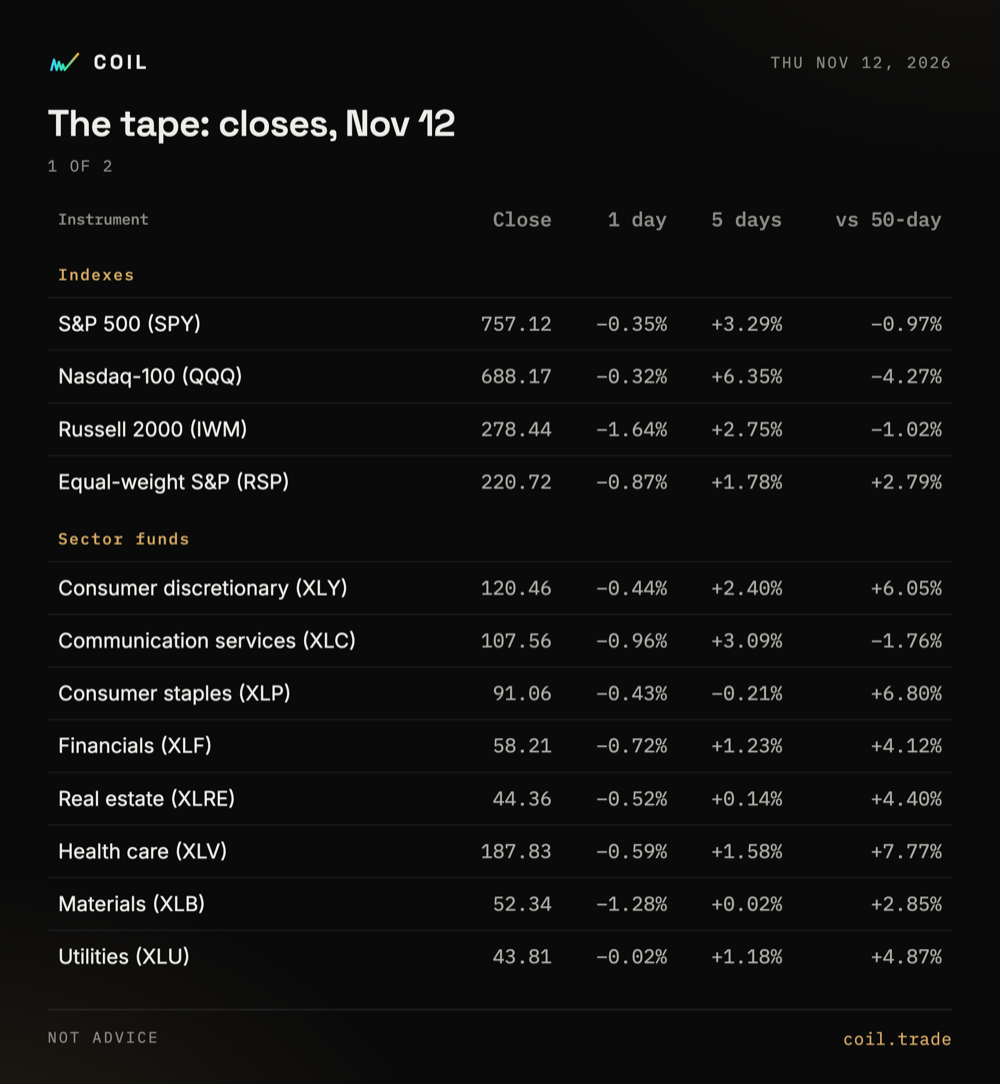
- Nvidia (NVDA) closed −4.34% at 166.19 on the day its chief executive resigned. AMD closed +5.86% and Broadcom (AVGO) +5.54%, while the cloud renters built on Nvidia's chips took the worst of it: CoreWeave (CRWV) −6.86% and Nebius (NBIS) −16.84%.
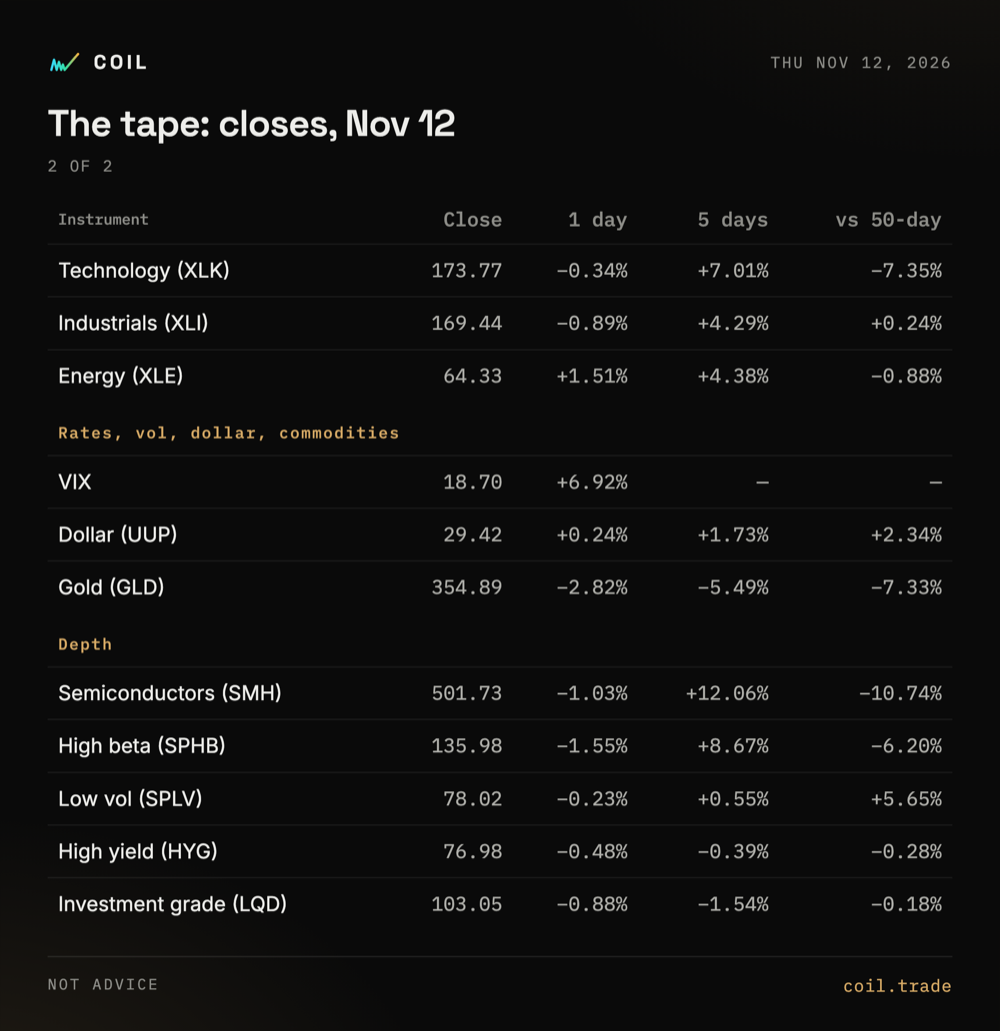
- Gold (GLD) fell −2.82% and the dollar fund (UUP) rose +0.24%, the third session running that the pair has moved this way. Investment-grade bonds (LQD) lost −0.88% with them.
- The VIX rose +6.92% to 18.70, so Wednesday's drop in fear reversed.
- The chip fund (SMH) slipped −1.03% to 501.73, which is still above the line our call needs it to finish under on Friday.
Nvidia lost its chief executive, and the chip trade stayed
Jensen Huang resigned as president, chief executive and a member of the board, effective immediately, Nvidia said in a filing dated Thursday. Colette Kress, the finance chief, is interim chief executive and keeps the finance job. Harvey C. Jones becomes the board's first chair, and the board is searching for a permanent chief executive inside and outside the company.
The tape treated it as one company's problem. The stock fell −4.34%, and the chip fund it sits inside slipped only −1.03%. The buyers went to the other chip designers, and the sellers went after the companies whose business is renting out Nvidia's hardware. The market priced the man and left the demand for the product alone.
Smaller stocks sold harder than the index, and the metals went first
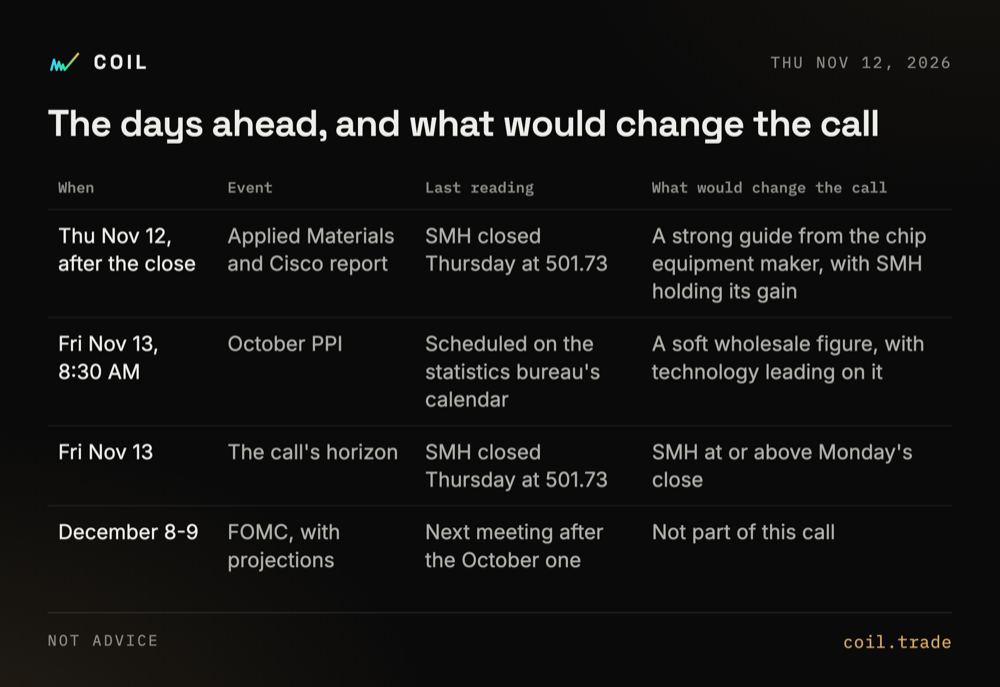
Expected against actual: we could not read a primary source for any release scheduled today, so we claim no beat and no miss. The producer price report for October comes on Friday at 8:30 AM, and that is the next hard number on the calendar. Applied Materials and Cisco report after Thursday's close. We have not read either release, and we say nothing about them beyond that they matter for the chip fund.
The index fell −0.35% and its equal-weight version fell −0.87%, so the largest companies did the holding up. The Russell 2000 fund (IWM) fell −1.64%, which is the clearest sign that the selling was wide even though the headline was quiet. Energy (XLE) rose +1.51% and was the only sector fund to close higher, with utilities flat. Materials (XLB) fell −1.28%, the most of any sector fund.
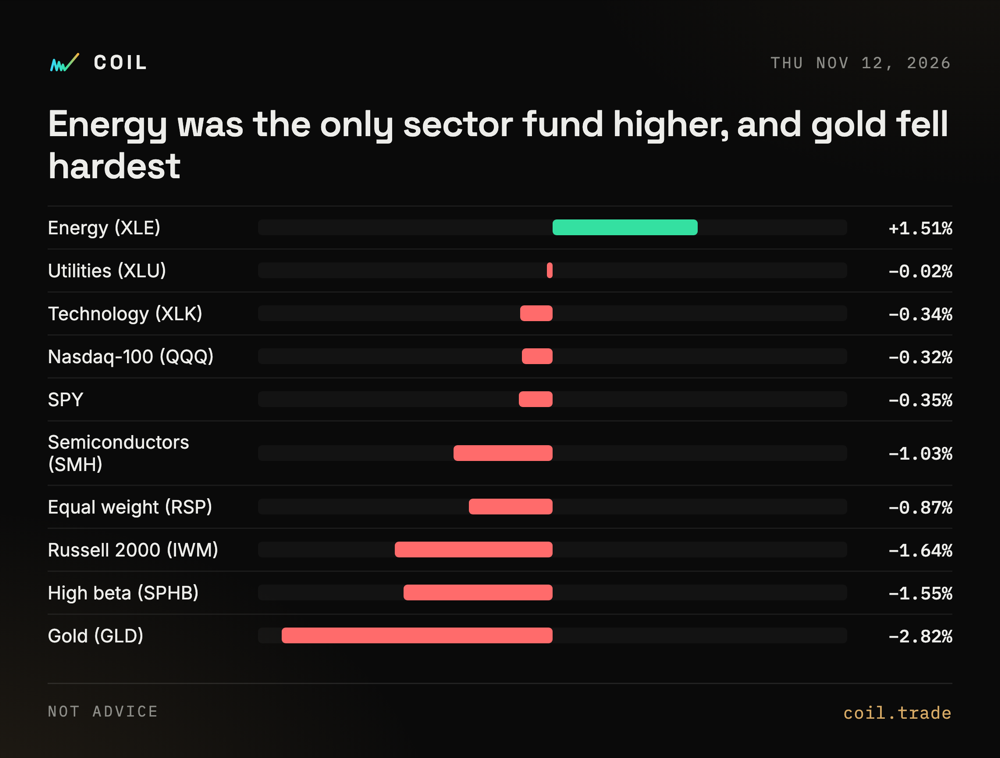
Our board says the same thing from the inside. Across the energy names we score, the typical one gained +1.24% and 81% of them finished up. The technology names we score fell a median −0.78%, with only 26% higher, so the chip fund's small loss hid a lot of red. The median materials name lost −1.92%, and just 8% of them rose. Not one of the 8 precious-metals names rose, and their median was −3.12%.
What it means for Friday
Chips had the best five sessions on the page and still sit a long way under trend. Applied Materials sells the machines that make the chips in that fund, so how it guides tonight is likely to move the group more than any inflation print will on Friday morning. A good guide would take away the one argument in our favour, which is that the rally has not repaired much. A cautious one would make the pullback easy to explain.
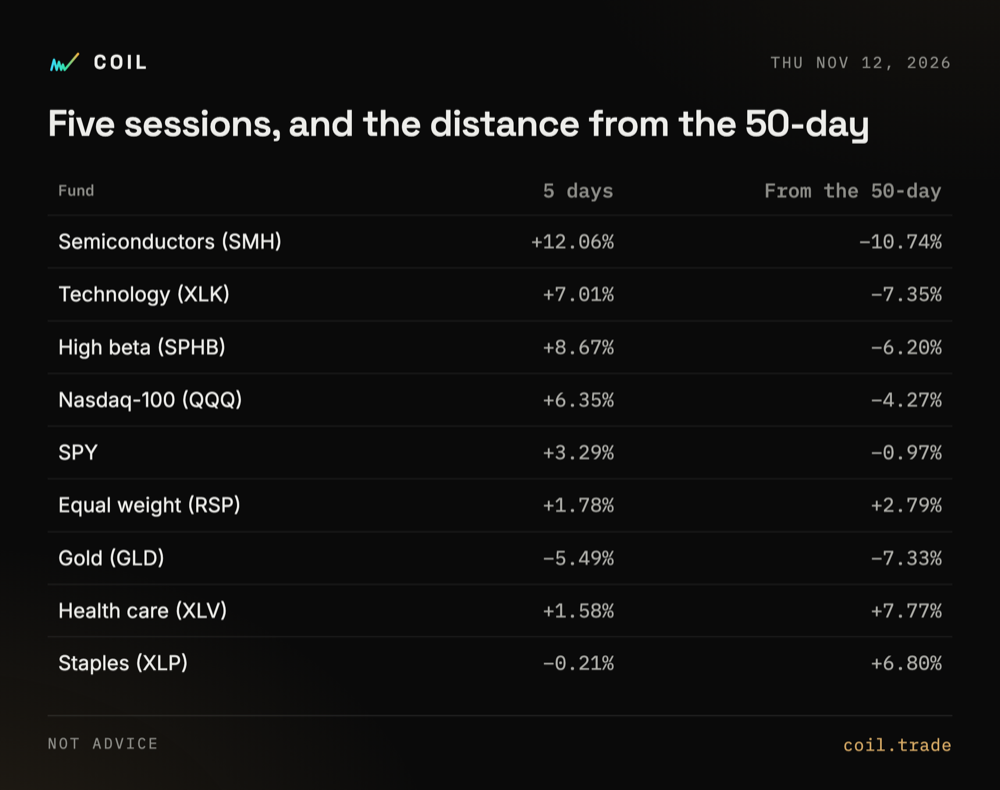
Gold is the odd one out. It is the only fund in the table that has lost ground over five days, and it sits well below its 50-day while the equal-weight fund sits above its own. That does not look like a market running to safety.
The book: a full turnover, mostly at small gains and small losses
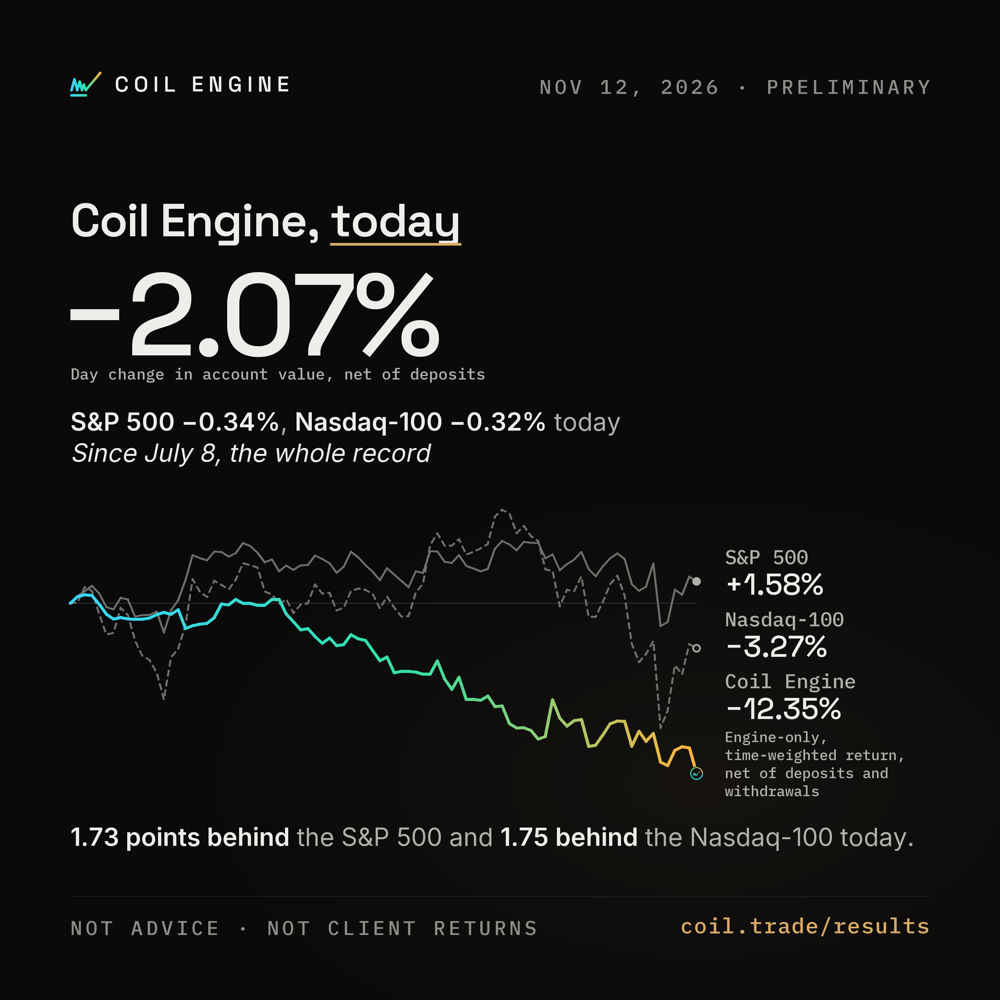
Coil Engine, Thursday Nov 12: −2.07%. S&P 500 (SPY): −0.34%. Nasdaq-100 (QQQ): −0.32%. Today's figure is preliminary until tonight's settle.
Since July 8, 2026, through Nov 11: Coil Engine −10.50%, SPY +1.93%, QQQ −2.96%. Engine-only, time-weighted return, net of deposits. Two down sessions held flat and one hand-placed trade removed: see /results.
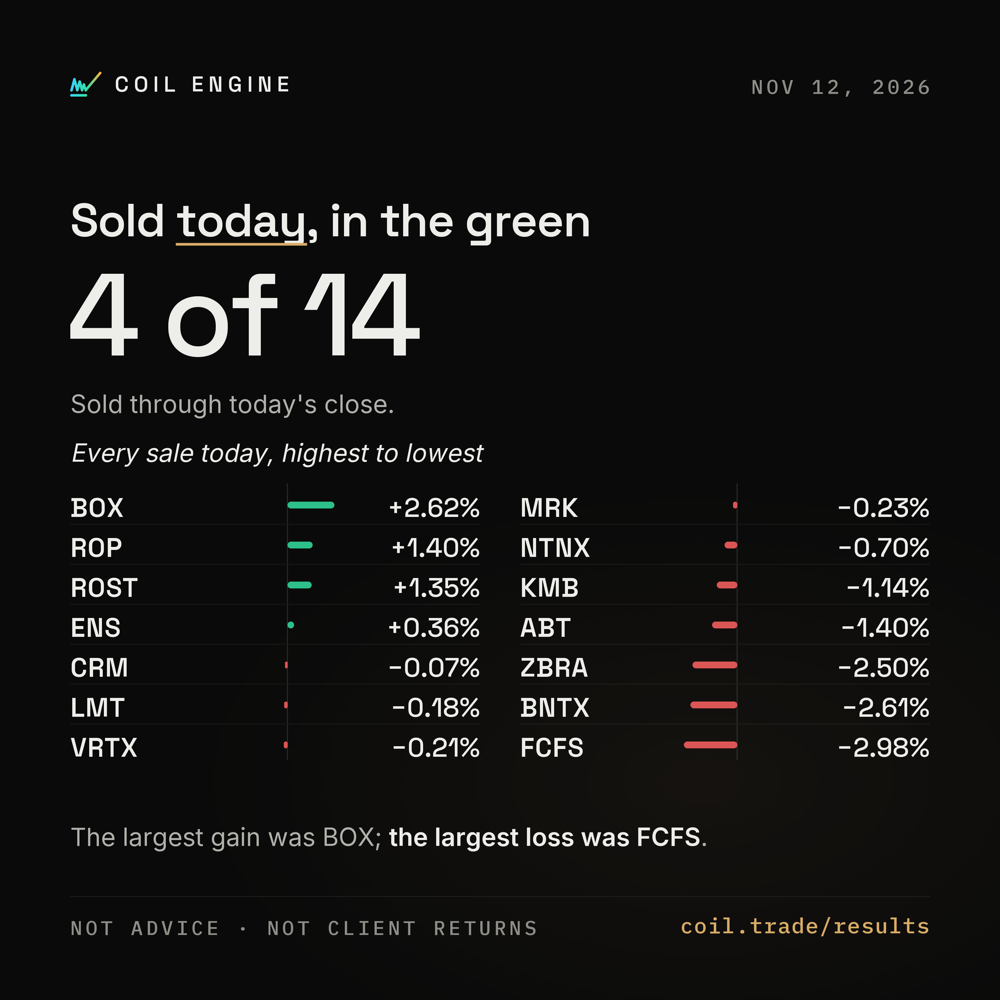
Out went 14 positions on Thursday, 4 of them at a gain and 10 at a loss. BOX closed at +2.62%, ROP at +1.40% and ROST at +1.35%. The three that hurt were FCFS at −2.98%, BNTX at −2.61% and ZBRA at −2.50%.
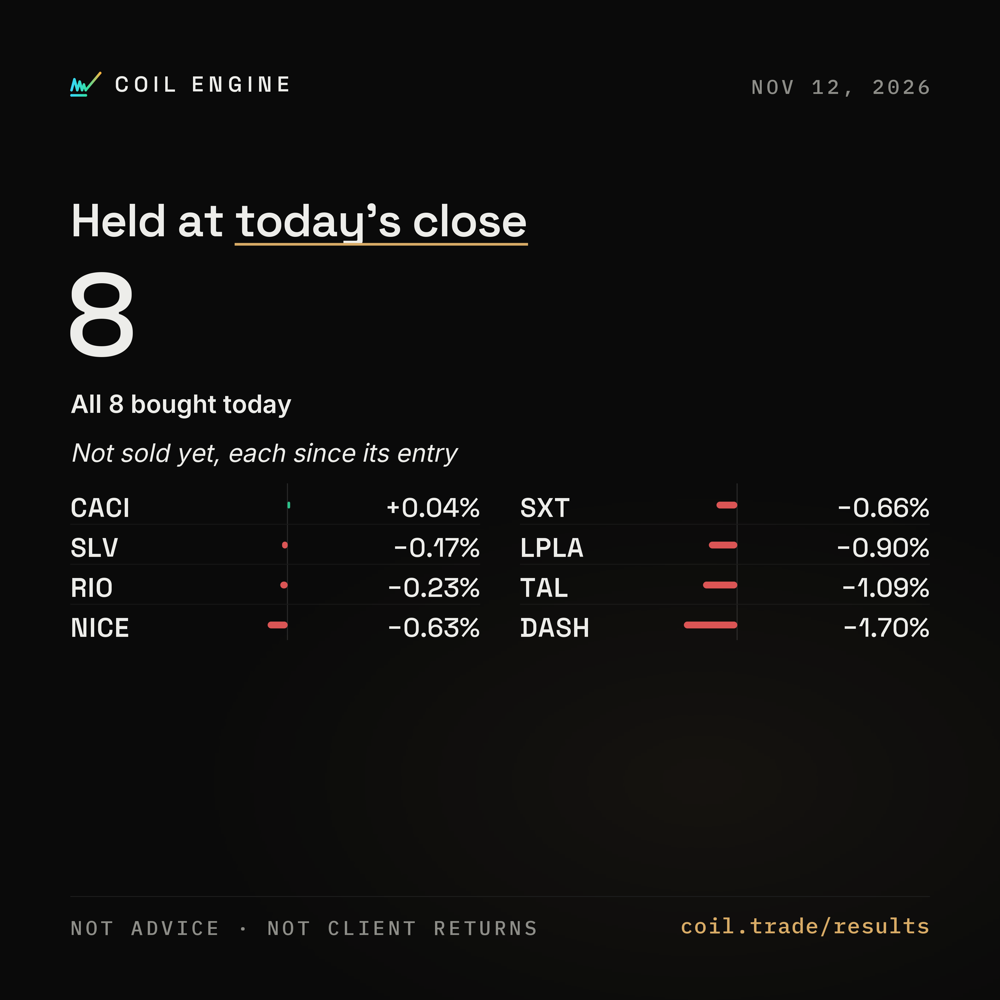
The mistake is the size of the reset. We ended the day with 8 positions, every one of them opened on Thursday, and the market they were opened into was one our own gate had shut. DASH is at −1.70% and TAL at −1.09%. We took SLV on a day when every precious-metals name on our board fell, and it sits at −0.17%. CACI is the only one in the green, at +0.04%.
We carry CACI, SLV, RIO, NICE, SXT, LPLA, TAL and DASH, and the rest is cash.
Our call
The common read is that losing the founder who built the AI boom's most important company is a blow to the whole chip trade. The chip fund's close says otherwise, and on that we agree with the tape. Where we differ is on what else moved. Gold, bonds and small caps all fell harder than the index, and the dollar kept rising. A market that was only resting would not charge for protection against all of that on the same afternoon.
Our engine's market gate reads cash on both the S&P 500 and the Nasdaq-100. Each index is above its 200-day and below its 55-day, and the gate opens nothing new beneath an index in that position. That fits the pullback and does not fit a bounce that is finished. Money already sits in health care, staples, dividend payers, consumer discretionary and utilities. It has left gold, technology and the metal miners. On that part the gate and the tape agree, since the money that left is the money that led the bounce.
Monday's call stands, word for word: We think SMH closes below Monday's close of 487.41 on Friday, November 13. It fails on one outcome: SMH closes at or above 487.41 on Friday, November 13. Three sessions in, SMH closed at 501.73, which is still on the wrong side of the line for us.
The other side has two real arguments. First, the fund is above our line by a wide margin, and one more session is not much time for it to close that gap. A strong report from the chip equipment makers tonight would end the call before Friday's inflation number arrives. Second, a market that sells small caps and metals while holding its largest stocks can be a market that is rotating cleanly into leadership, and the Nasdaq-100 fund lost less than the index on a day the VIX rose.
The book sits against the call and against the gate. We opened every position we hold today into a gate that ended the day shut, which is the timing mistake described above.
What we are watching is the same pair of lines. If the S&P 500 closes back above its 55-day with its trend intact, the gate opens and the pullback has earned a second look. If it turns lower from there, the gate was right to stay shut.
One call is open on the scorecard, due on November 13.
The gate, the sector map and the list of names at an entry are the reads an AI agent gets when it connects to Coil as an agent tool, and the same ones it can buy singly with x402. The free tools need no key: coil.trade/connect.
What's next
Keep reading
Thursday shows how a quiet index can sit on top of a much weaker market, and the way to read what lies under the headline is laid out in plain terms at coil.trade/learn, next to each close note and the Friday Wrap.
Our full record is at coil.trade/results.
Not advice.
COIL CLOSE is impersonal market commentary. It states a dated view of a market instrument, graded against its stated test, and is not investment advice, a recommendation or an instruction to trade, and is not tailored to anyone’s circumstances. Figures and prices are as of the time stated above.