Chips took Tuesday back in one session and left our call behind
Published Nov 11, 2026, 1:51 PM PT. Figures and prices are as of that date; the current record is at /results.

Prices as of 1:46 PM Pacific on Wednesday, each an official close. Coil Engine figures stay preliminary until tonight's settle.
There was no scheduled data release today, so the tape had to explain itself, and what it showed was money going back into the group it left on Tuesday. The easy conclusion is that the selloff has ended. We think it is a bounce inside a downtrend, since the chip fund still sits well under its 50-day average. Monday's call on that fund is now behind and we leave it standing, and the book sold its defensives and bought technology back.
What changed
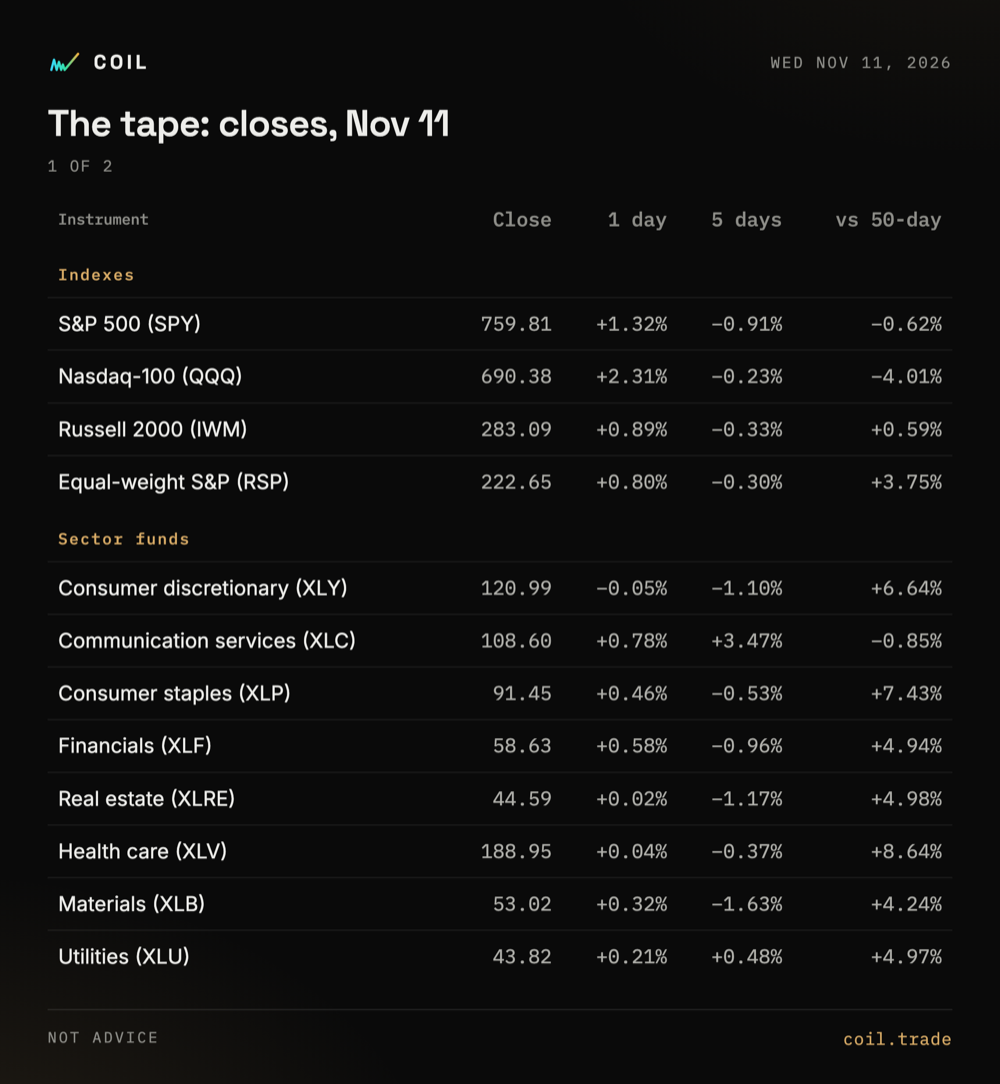
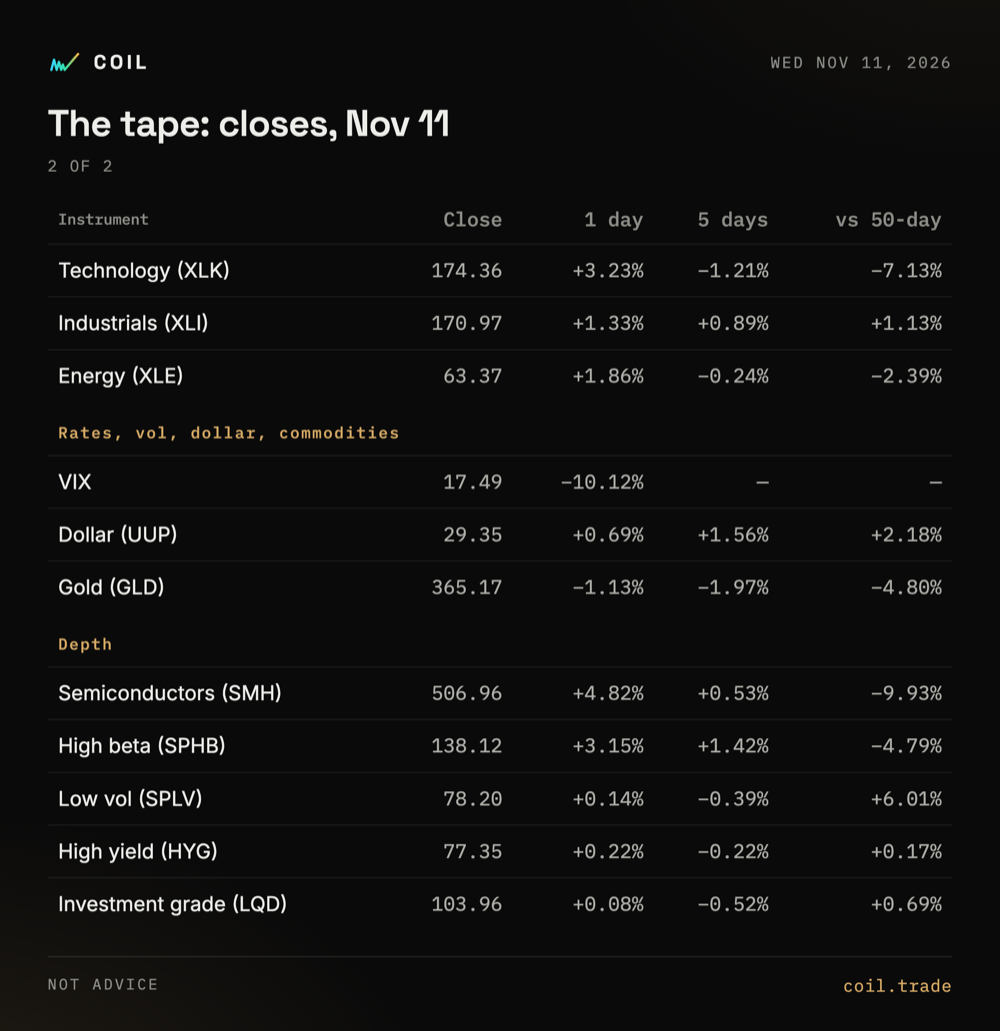
- The chip fund (SMH) rose +4.82% and closed at 506.96, above the line our call needs it to finish under on Friday.
- Technology (XLK) gained +3.23% while the dollar fund (UUP) rose +0.69% and gold lost −1.13%, the same pair of moves as Tuesday. Tuesday's rates explanation for technology did not survive the day.
- The VIX fell −10.12% to 17.49, so the bounce came with fear coming out of options.
Technology came back, and the old explanation went quiet
Expected against actual: the labour department's schedule lists no release for today, and the next one on it is the producer price report on Friday. With no print there is no consensus to beat or miss, and we claim neither.
On Tuesday we wrote that gold, bonds and high-beta stocks fell together, and that this pointed at rate expectations as the driver. Part of that held. Gold fell again, by −1.13%, and the dollar rose again. But technology went the other way and rose +3.23%, and high beta (SPHB) rose +3.15%. If rates were the whole story, those two groups could not have bounced into a stronger dollar. They did. So rates explain gold and the dollar this week, and something else explains the chips. We did not find a primary source for what that something is, and we will not guess at one.
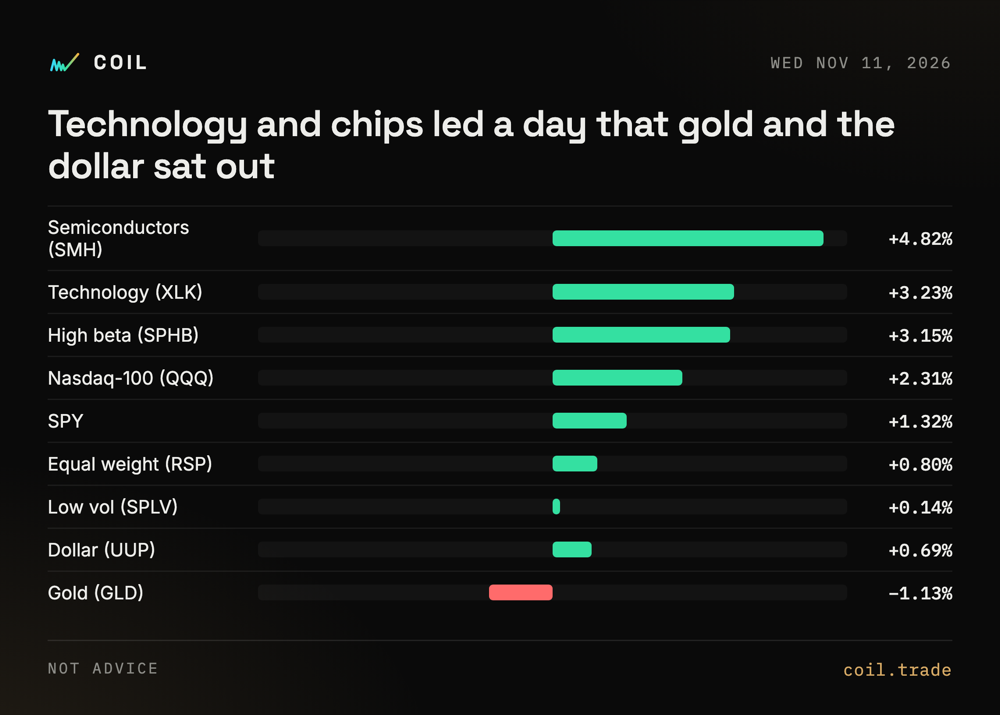
The index ran ahead of its equal-weight version, so the largest members did most of the lifting again, this time in the right direction. Low volatility sat the day out. Consumer discretionary (XLY) was the only sector fund to close lower, by −0.05%.
Our board shows that this was a wide move inside technology and not a few big names. Across the technology names we score, the typical one gained 3.07% and 90% of them finished up. All 24 of the energy names were higher, with a median of 2.48%. At the other end, only 1 of the 8 precious-metals names rose, and the median was −1.15%. Real estate had 30% of its names higher.
What it means for the rest of the week
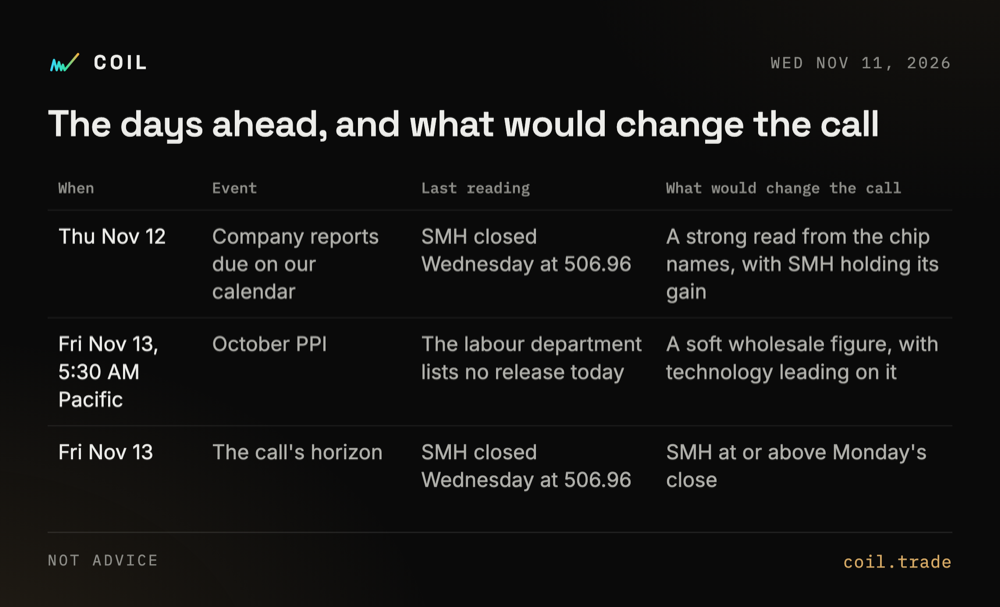
Start with where the chip fund is, not where it was. After a gain this size it is still −9.93% from its 50-day average, and the Nasdaq-100 fund is −4.01% from its own. A bounce that leaves both of them that far below trend looks the same on its first evening whether it is a turn or a pause in a downtrend. The table below is what we would watch to find out which.
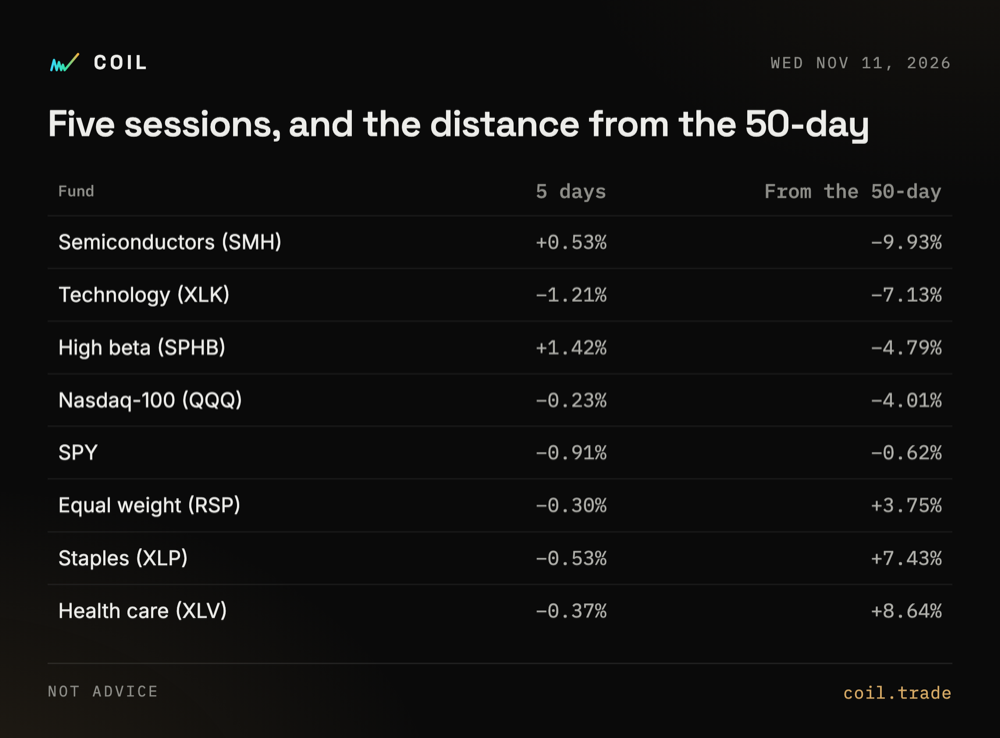
Staples and health care are the groups sitting furthest above trend, and they did very little today. That is the shape of a market that has been paid to hide and has not yet been paid to leave.
The book: out of the defensives, back into software
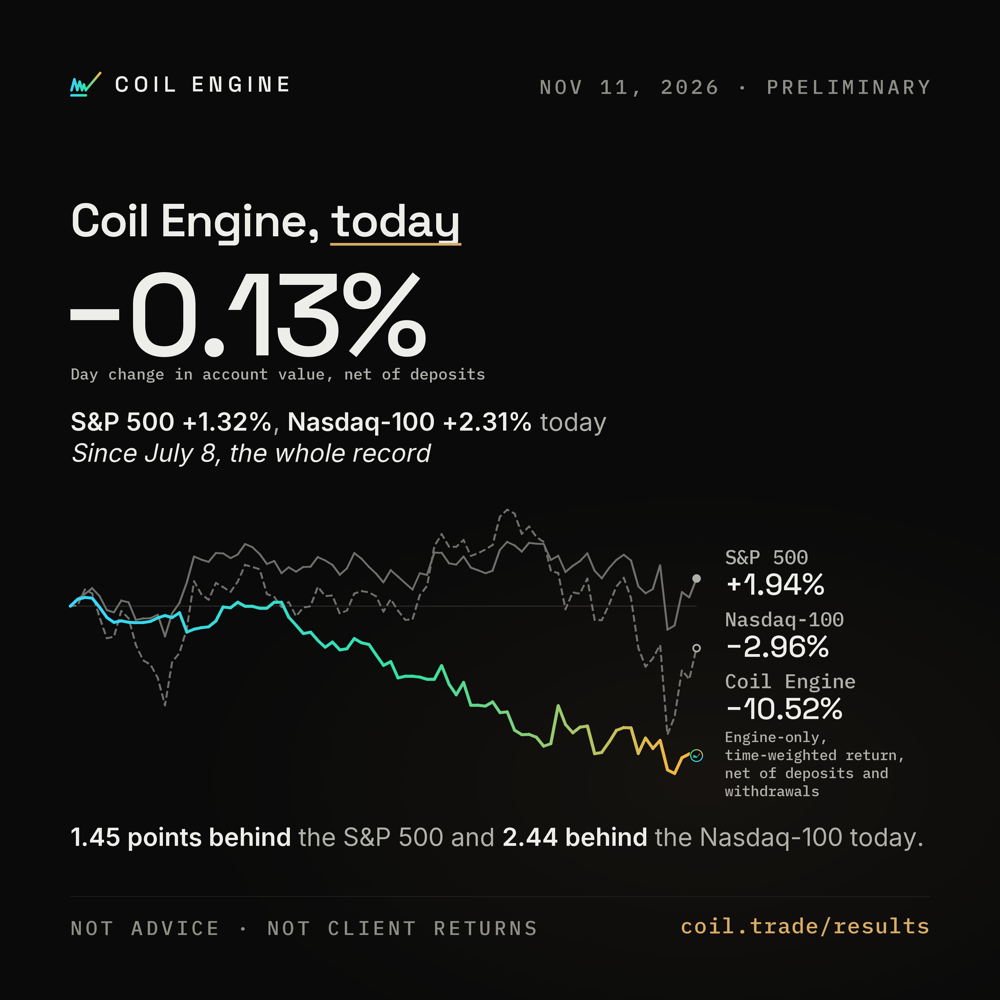
Coil Engine, Wednesday Nov 11: −0.13%. S&P 500 (SPY): +1.32%. Nasdaq-100 (QQQ): +2.31%.
Since July 8, 2026, through Nov 10: Coil Engine −10.41%, SPY +0.61%, QQQ −5.16%. Today's figure is preliminary until tonight's settle.
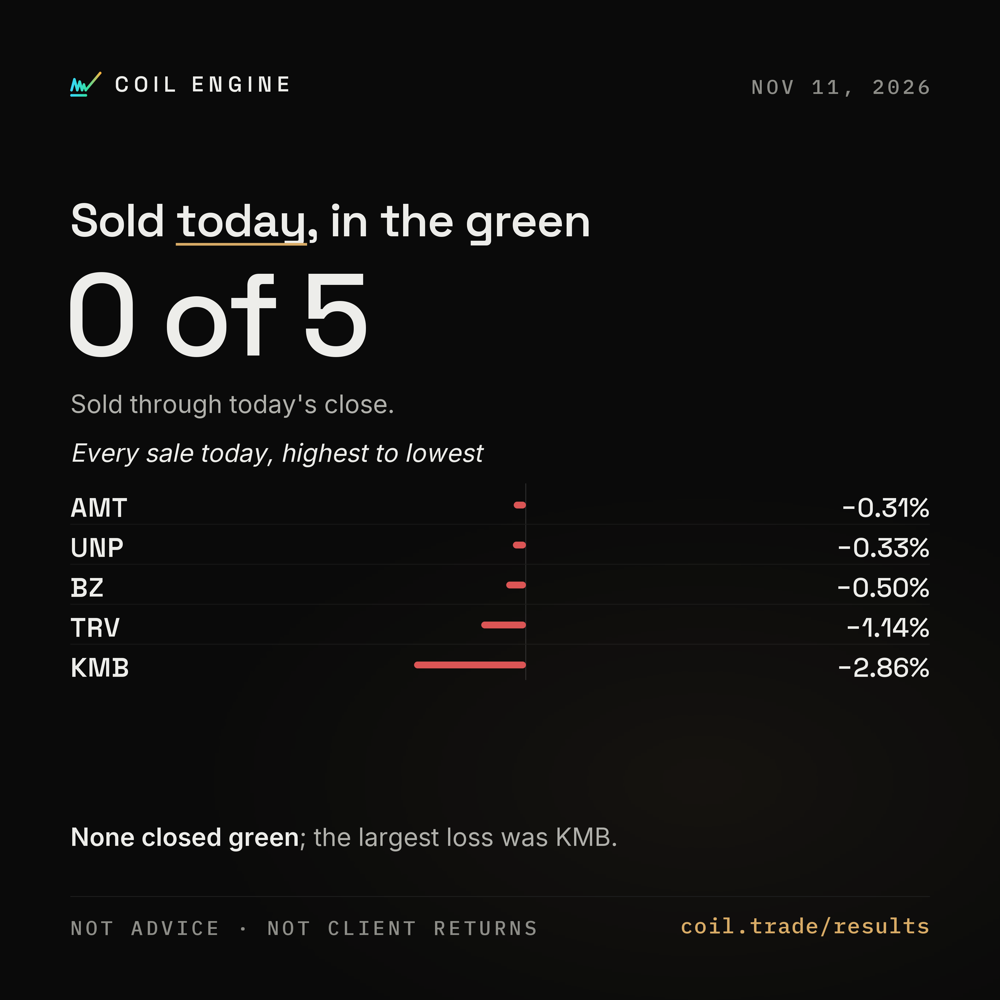
We closed 5 positions on Wednesday and every one was a loss. The largest was KMB at −2.86%. TRV closed at −1.14%, BZ at −0.50%, UNP at −0.33% and AMT at −0.31%.
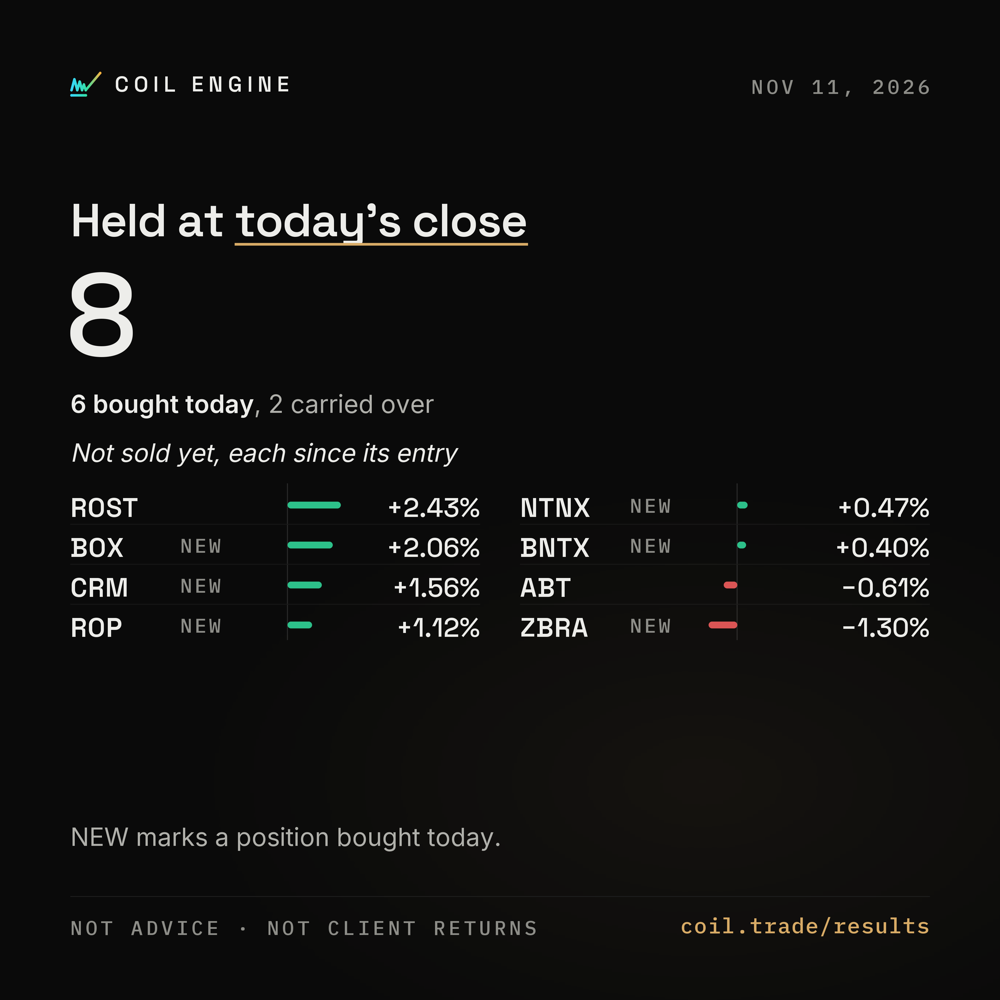
The mistake is one of timing, and it is ours. On Tuesday we sold CRM and NTNX at small losses, and on Wednesday we hold both again. We opened 6 new positions in all, and they were bought into a sharp technology rally, so the book is exposed to a bounce we have just said we do not trust. CRM is at +1.56% and NTNX at +0.47% so far. ZBRA is the one underwater, at −1.30%.
We carry ABT, BNTX, BOX, CRM, NTNX, ROP, ROST and ZBRA, and the rest is cash.
Our call
The common read of today is that Tuesday was an overreaction and the buyers are back. There is real support for that view, since breadth inside technology was wide and the VIX dropped. We agree buyers came back. One session proves less than that, though. A group that is −9.93% from its 50-day does not repair that in a day, and the dollar and gold are still moving the way they did when technology was being sold. If the bounce is real, those two should stop.
Our engine's market gate does not agree that the selling is over. Going into the close it read cash on both the S&P 500 and the Nasdaq-100, for one plain reason: each index is above its 200-day and still below its 55-day, and the gate opens nothing new under an index in that position. It reads leadership the same way. Health care, staples and dividend payers are where money already sits, and technology is still on the list of groups money has left, even after a day like this one.
We have not changed Monday's call. We think SMH closes below Monday's close of 487.41 on Friday, November 13. What would prove us wrong is plain: SMH closes at or above 487.41 on Friday, November 13. Two sessions in, SMH closed at 506.96, which is on the wrong side of the line today.
The other side has two good arguments. First, the fund is already above our line, and a call that needs a full day's gain given back inside two sessions is asking a lot, with the producer price report arriving Friday morning to decide it either way. Second, the bounce came on falling volatility and a wide base inside technology, and a move with that much behind it can keep going.
The book now sits against the call. We hold several technology names while the call says the chip fund falls, so the book is leaning the other way from our own words.
Our book did not wait for the gate. It opened six positions on a day the gate ended shut, which is the timing mistake described above.
What we are watching is simple to state. If SPY closes back above its 55-day with its trend intact, the gate opens and the bounce has earned a second look. If it turns down from there, the gate was right to stay shut.
The scorecard holds one open call, made on November 9 and due on November 13.
The gate, the sector map and the list of names at an entry are the same reads an AI agent gets when it connects to Coil over MCP, or buys one read at a time with x402. The free tools need no key: coil.trade/connect.
What's next
Keep reading
Wednesday is a good case of a bounce that looks like a turn and has not yet shown that it is one, and the way to tell a bounce from a turn is covered in plain terms at coil.trade/learn, next to each close note and the Friday Wrap.
Our full record is at coil.trade/results.
Not advice.
COIL CLOSE is impersonal market commentary. It states a dated view of a market instrument, graded against its stated test, and is not investment advice, a recommendation or an instruction to trade, and is not tailored to anyone’s circumstances. Figures and prices are as of the time stated above.