Inflation slowed and the market sold technology anyway
Published Nov 10, 2026, 1:33 PM PT. Figures and prices are as of that date; the current record is at /results.

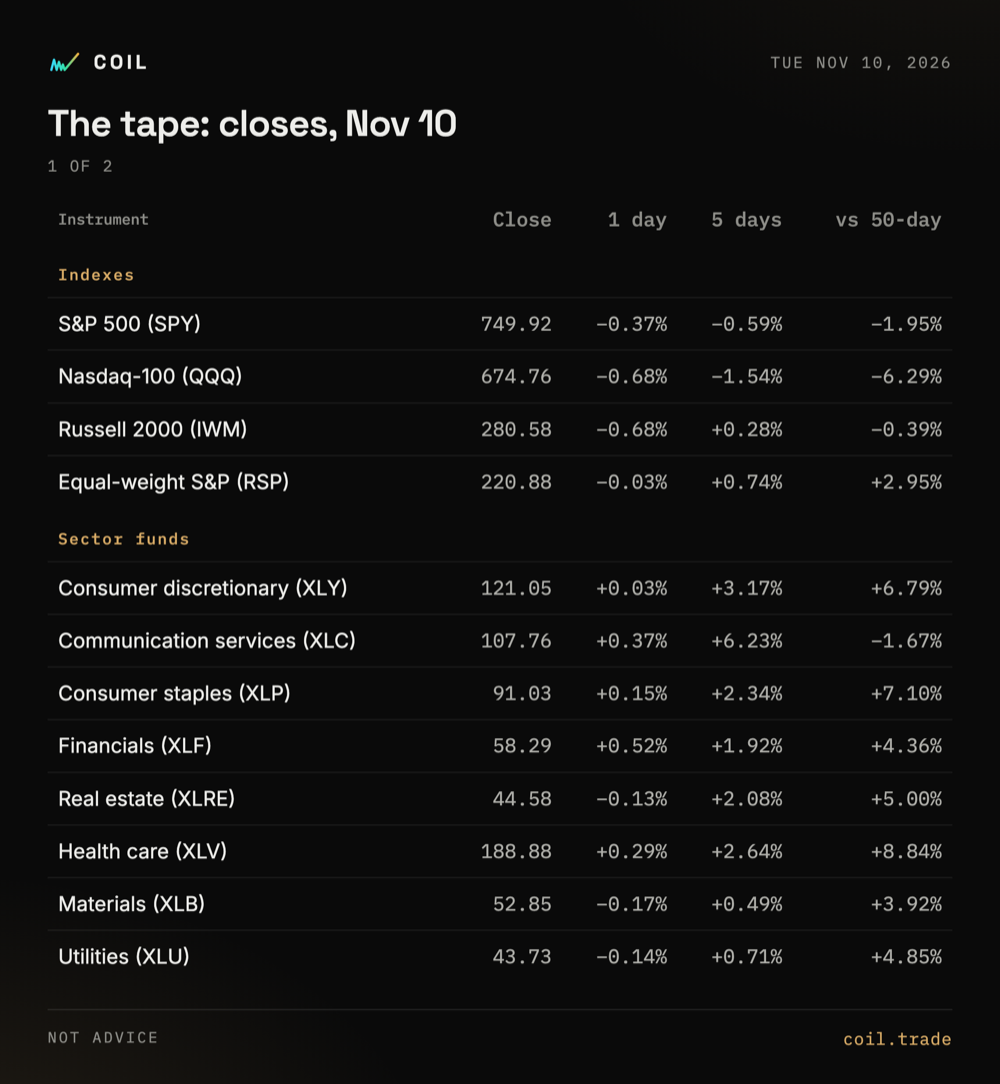
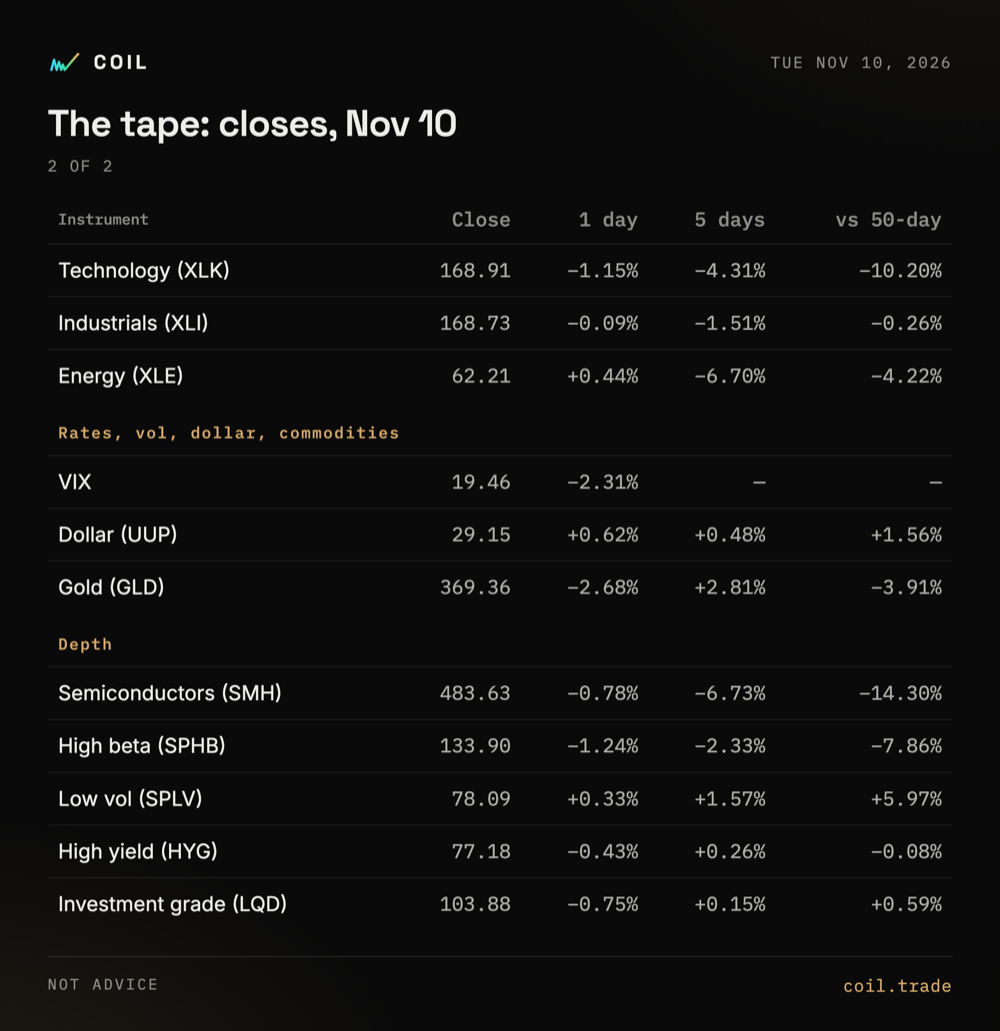
Prices as of 1:31 PM Pacific, each one Tuesday's official close; tonight's settle will make the preliminary Coil Engine figures final.
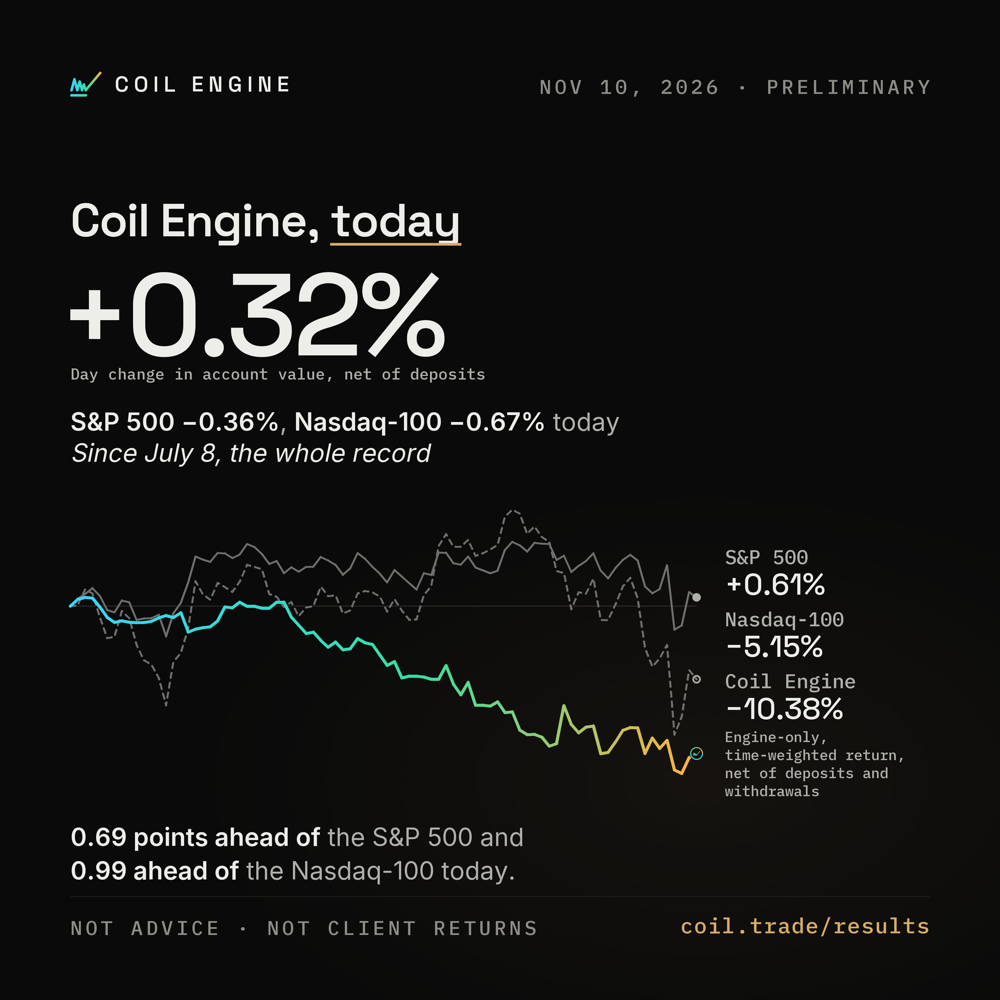
October's CPI rose 0.4% on the month, down from 0.6% in September, and the market still sold what it bought on Monday. Most people will read Tuesday as a technology selloff. We read it as a rates day, because gold, corporate bonds and high-beta stocks fell together while the dollar rose and the average stock went nowhere. Monday's call on the semiconductor fund stands, and the book closed its software names and ended the day in defensives.
What changed
- The inflation print is in, and it settled less than the market hoped. Prices rose more slowly than in September and the core rose 0.3%, a pace that still leaves the two Fed officials who wanted a hike with an argument.
- Monday's leaders became Tuesday's laggards. High beta (SPHB) fell −1.24% and technology (XLK) −1.15%, so the bounce lasted one session in the groups that needed it most.
- There is no twelve-month inflation rate for October. The statistics bureau did not collect prices in October 2025 during the lapse in appropriations, so it had no base to measure against and published none.
The print was slower, and the rate-sensitive trade fell on it
Expected against actual: we found no consensus figure in a primary source, so we claim no beat and no miss. Against the prior month the print was better. Headline CPI rose 0.4% after 0.6% in September. Core prices rose 0.3%, shelter rose 0.3% and energy 0.7%.
A slower month would normally help the stocks that fear higher rates. On Tuesday those stocks fell, and the company they kept says why. Gold lost −2.68%. Investment-grade corporate bonds (LQD) fell −0.75% and high yield (HYG) −0.43%. The dollar fund (UUP) rose +0.62%. Assets that pay nothing, or pay far in the future, lost value against cash on the same day, and that is what a market does when it marks the path of rates higher.
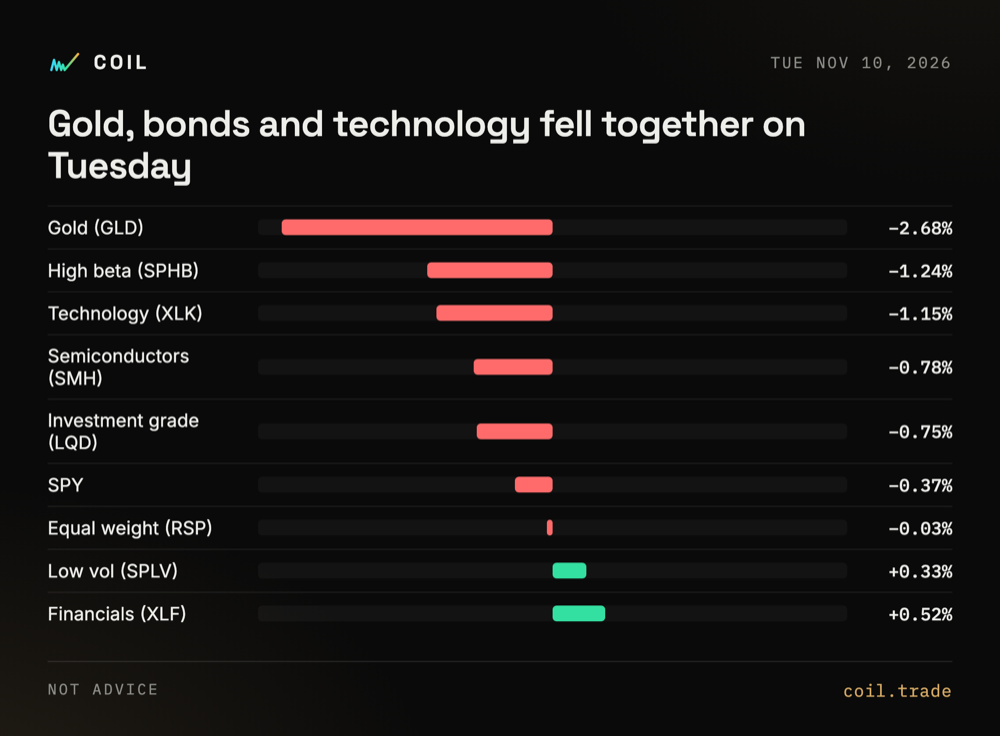
The index fell −0.37% and the equal-weight version of it closed −0.03%. Nearly all of the index's loss came from its largest members, which are technology companies. Financials, energy, communication services and health care all closed higher, and financials tend to like the prospect of rates staying up.
Our own board shows how narrow the damage was in stocks and how complete it was in bonds and metals. The median Information Technology name we score fell 0.52%, with 38% of them higher. Materials did worse, with a median of −1.24% and 26% higher. None of the 9 bond funds on the board closed up, and none of the 8 precious-metals names did either, where the median loss was 5.13%. Energy names had a median gain of 0.39%.
What the print means for December
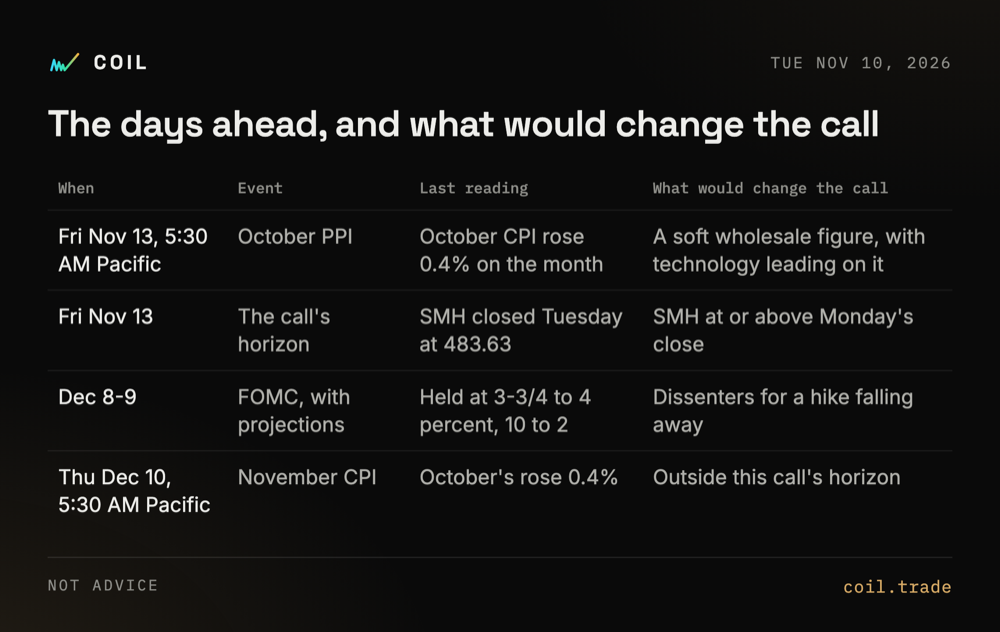
For the read-through, start at the Fed and end at the long-duration corner of the stock market. On October 28 the vote to keep the Fed's target range at 3-3/4 to 4 percent was 10 to 2, with the pair of dissenters asking for an increase. The committee meets again on December 8-9 and will publish fresh projections that day. A core rate of 0.3% a month does not end the argument for a hike, and the missing twelve-month figure takes away the number most people use to judge progress.
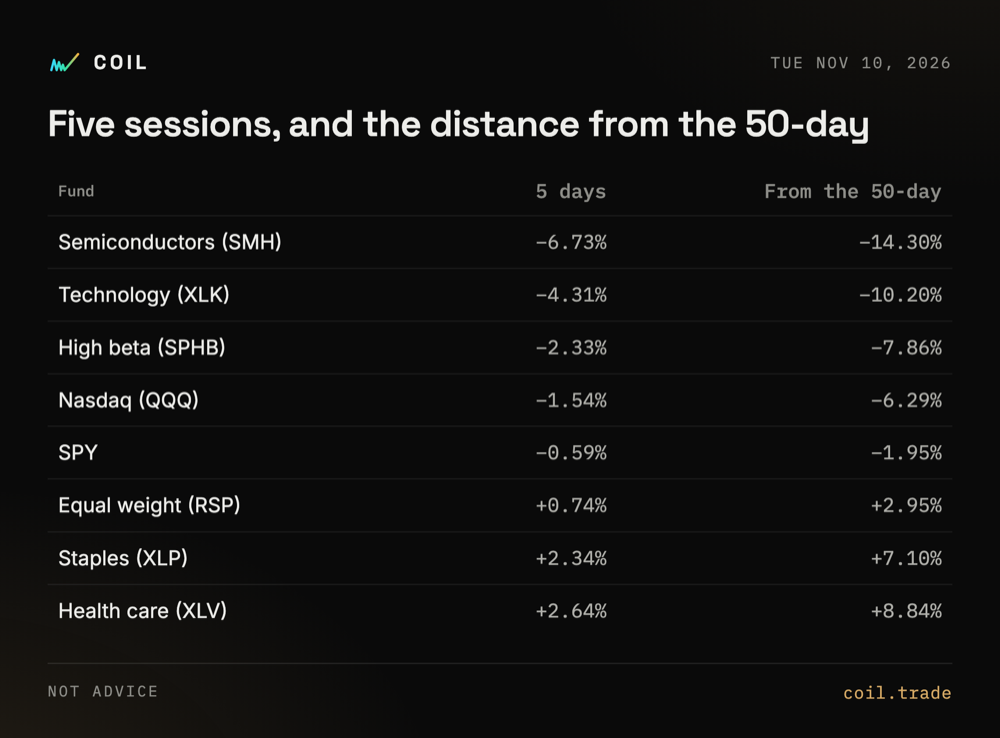
That uncertainty lands hardest on the groups already in the weakest position. The five-session and 50-day columns below show a market that has been moving money from technology into defensives for weeks, and Tuesday continued it after a one-day pause.
The book: out of software one day after buying it
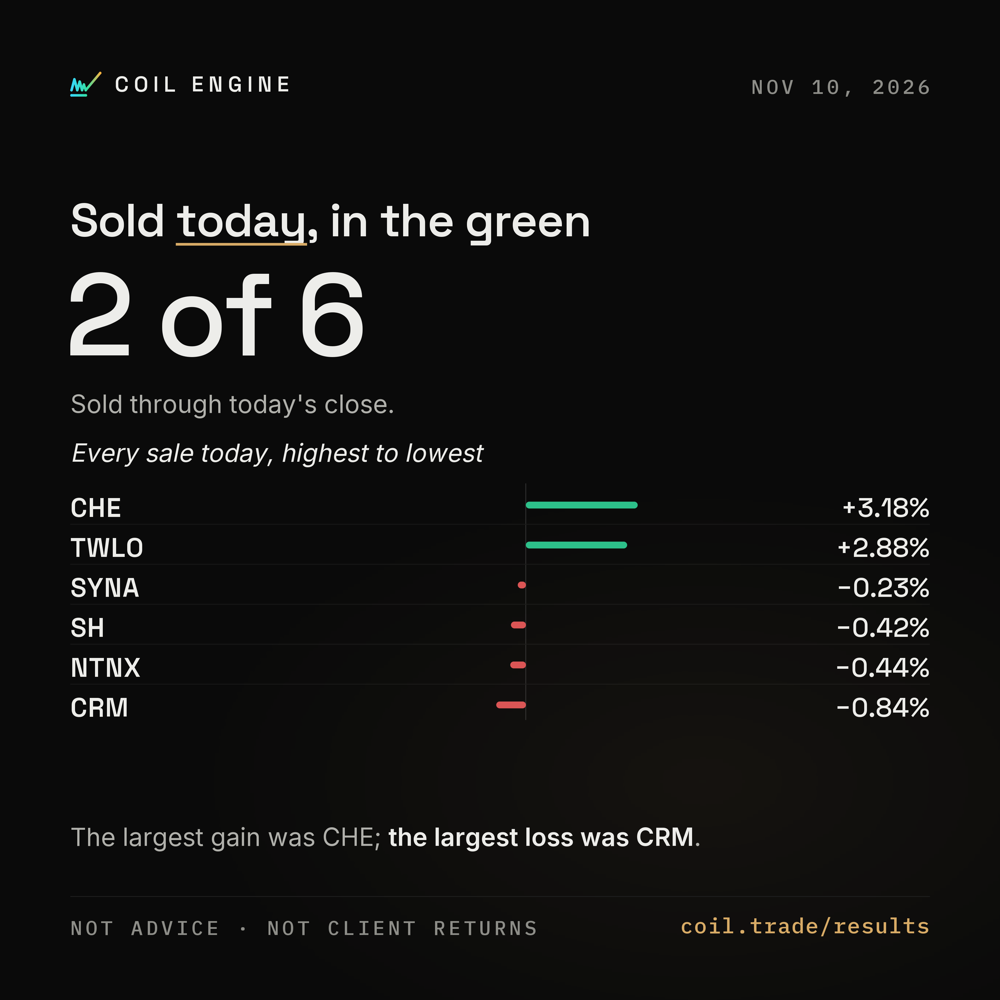
We closed 6 positions on Tuesday, 2 green and 4 red. The two winners were CHE (+3.18%) and TWLO (+2.88%). CRM at −0.84%, NTNX at −0.44% and SYNA at −0.23% were small losses.
We sold SH at −0.42%.
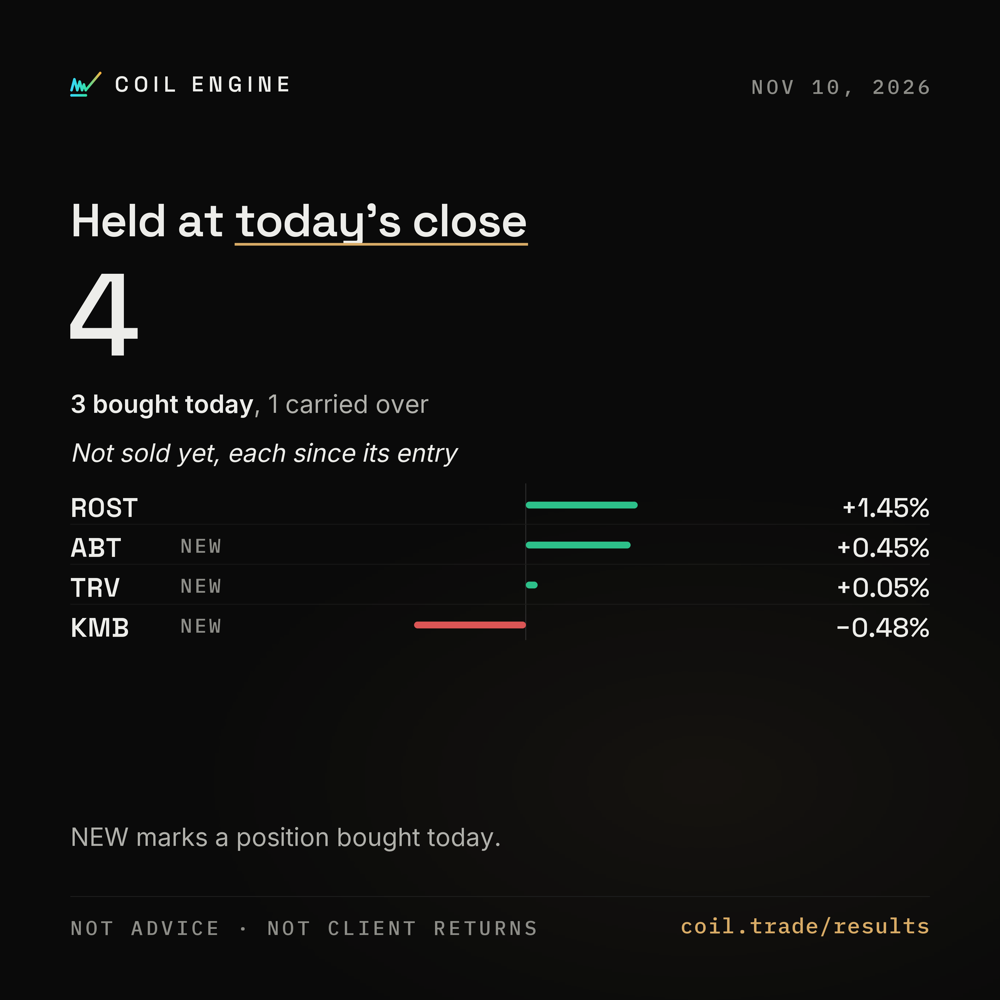
The mistake was Monday's. We wrote that the bounce in technology was relief and then bought software into it, so the book sat against our own call. Tuesday proved the call right for a day and the book paid for the purchases: three of the four software and chip names came out red. We opened 3 new positions on Tuesday, in health care, insurance and staples, which is where the market has been comfortable all month.
We carry ABT, KMB, ROST and TRV, and the rest is cash.
Our call
Most of the market will file Tuesday as a bad day for technology after a good one, on a print that was fine. The evidence for that view is the print itself, which slowed from September. We agree inflation slowed. Where we differ is on what moved. Gold falling −2.68% with the dollar up +0.62% has nothing to do with chip demand, and it points to rate expectations as the driver. If that is right, technology's problem lasts until the Fed speaks in December.
Monday's call stands, word for word: We think SMH closes below Monday's close of 487.41 on Friday, November 13. It fails on one outcome: SMH closes at or above 487.41 on Friday, November 13. One session in, SMH closed at 483.63.
The other side has a pair of good arguments, and we give them at full strength. First, the print did slow, and a market that sold on the day can change its mind once it has read the detail, with the most oversold group gaining the most. Second, SMH sits −14.30% from its 50-day average, and a fund that stretched can jump on any piece of good news from a single large chip company.
The book now sits with the call. None of the four names we carry is a technology stock.
The scorecard holds one open call, made on November 9 and due on November 13.
What's next
Keep reading
Tuesday is a good case of an inflation number and a stock market disagreeing about what the number meant. Why rate expectations move some groups far more than others is explained in plain terms at coil.trade/learn, next to each close note and the Friday Wrap.
Our full record is at coil.trade/results.
Not advice.
COIL CLOSE is impersonal market commentary. It states a dated view of a market instrument, graded against its stated test, and is not investment advice, a recommendation or an instruction to trade, and is not tailored to anyone’s circumstances. Figures and prices are as of the time stated above.