Nvidia slid again while the average stock climbed
Published Nov 25, 2026, 1:27 PM PT. Figures and prices are as of that date; the current record is at /results.


Prices as of 1:25 PM Pacific today, Wednesday, all official closes. Coil Engine beta figures for today stay preliminary until tonight's settle.
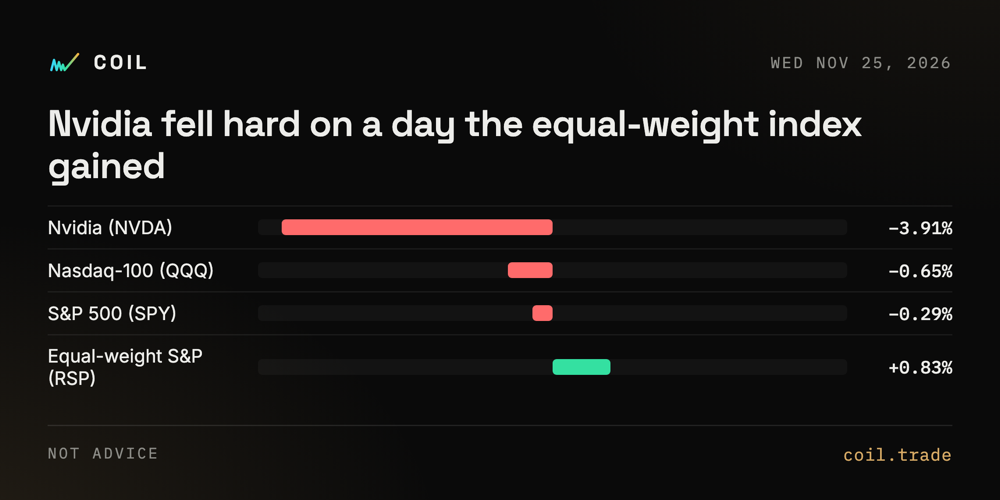
Nvidia closed −3.91% on Wednesday as the equal-weight S&P fund rose +0.83%, leaving the damage with a handful of giants. Micron at −4.53% and Amazon at −3.12% added to the drag, which is why QQQ finished −0.65% and SPY −0.29% with most sector funds green. We see money moving out of the crowded names and into everything else, and one good session for the rest doesn't repair either index. Our book sold bonds and a few single names and ended the day holding six fresh positions.
Nvidia, Micron and Amazon held the indexes down
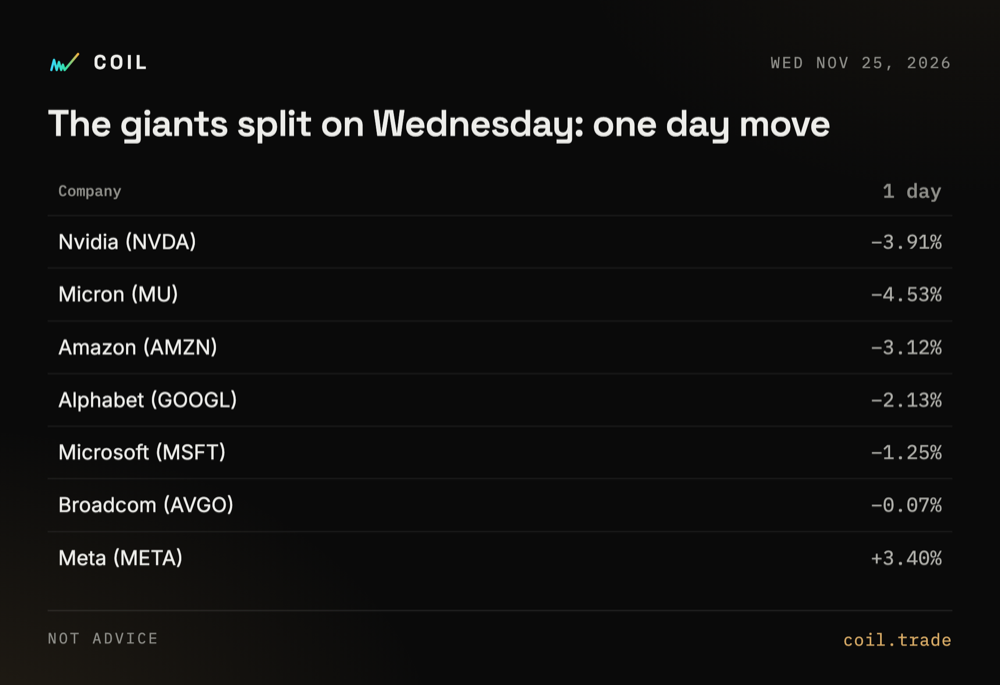
On Wednesday, November 25, 2026, Nvidia (NVDA) closed at 149.30, a move of −3.91% on the day and −1.10% across five sessions. Micron (MU) closed −4.53% and Amazon (AMZN) −3.12%. The S&P 500 fund SPY ended −0.29% and the Nasdaq-100 fund QQQ −0.65%.
We could not confirm a cause from the company's own filing, so we give none. Nvidia's latest Form 8-K we read is the one from this week that put Jensen Huang back as President, Chief Executive Officer and director. Its release says the board voted unanimously and that a committee made up only of independent directors is investigating. Nothing in it explains Wednesday's tape.
What the tape does show is a stock far under its own trend. Nvidia sits −27.15% from its 50-day line. A name that big, falling this far below its own trend, keeps pulling on both indexes whether or not there is a headline.
Micron's week is worse, with a five-session move of −14.75%. Sandisk, the other large memory name on our board, fell −5.57%, and AMD ended lower at −1.75%. We have no confirmed cause for Micron, Sandisk or AMD either, and we won't borrow one from the group.
The read-through was uneven, which matters more than the headline drop. Meta went the other way at +3.40%, while Alphabet fell −2.13% and Microsoft −1.25%. Broadcom barely moved at −0.07%. The chip fund SMH ended −1.01%, a smaller loss than Nvidia or Micron took on their own, so buyers were willing to hold parts of the group.
Materials led and the equal-weight fund beat the giants
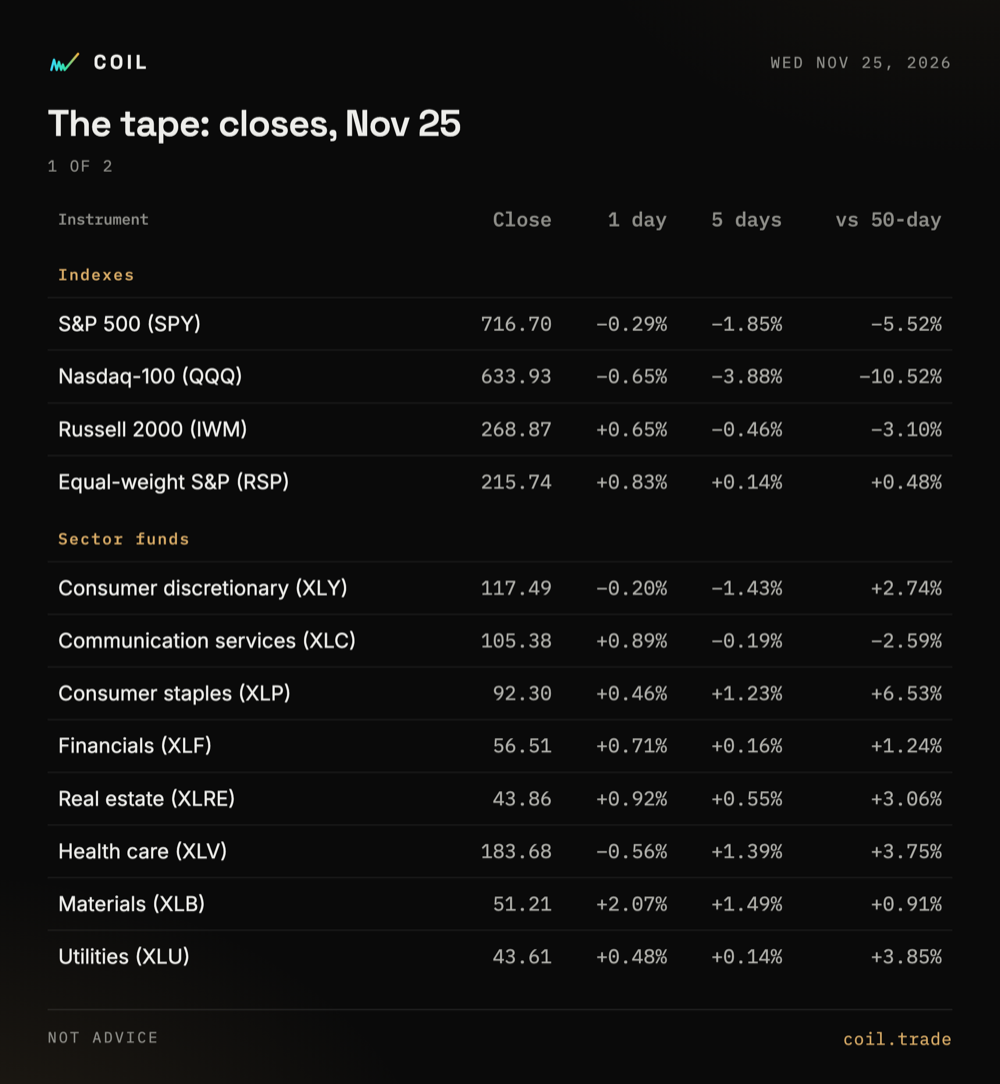
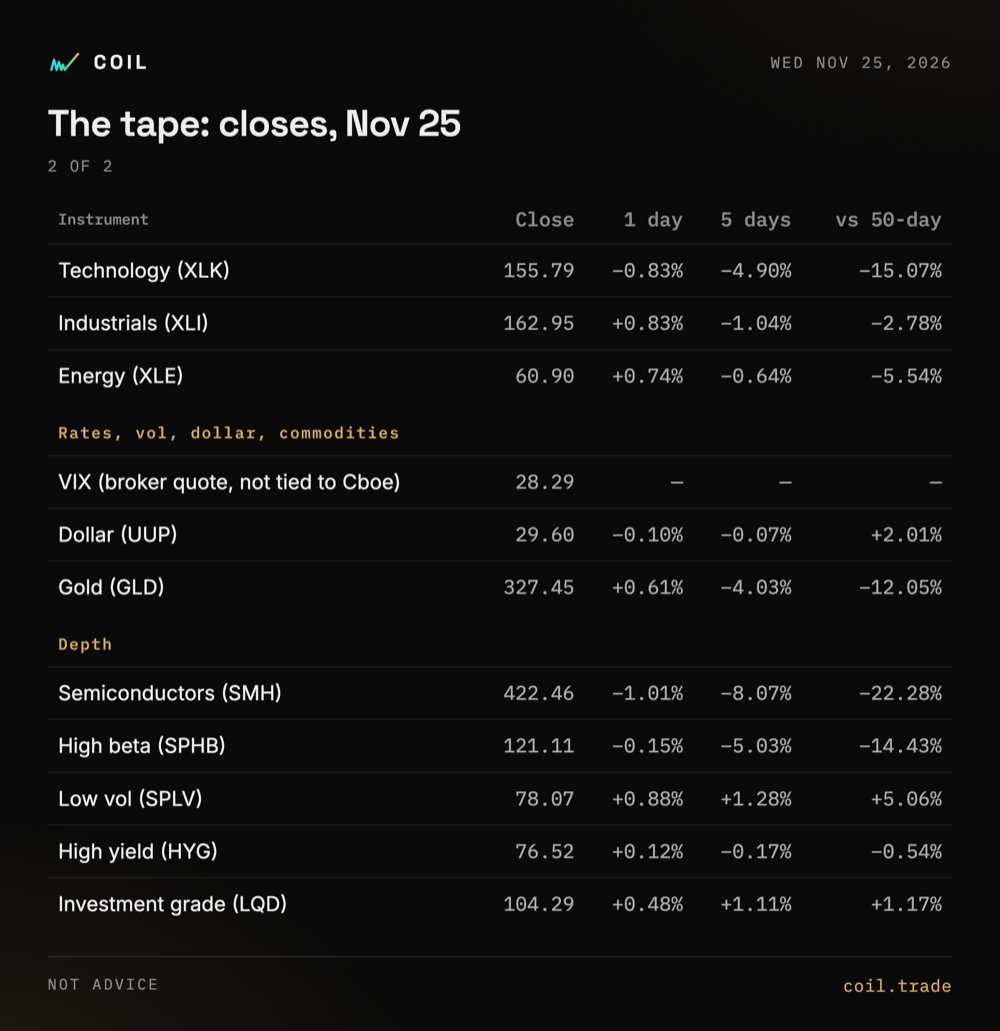
Materials ran away from the other sector funds at +2.07%. Real estate added +0.92%, communication services +0.89% and industrials +0.83%, and financials and energy joined them. Only technology, health care and consumer discretionary closed lower, at −0.83%, −0.56% and −0.20%. Discretionary's loss looks like Amazon's weight at work, because the typical name in that group rose on our board.
Small caps took part, with IWM at +0.65%. Low volatility, SPLV, gained +0.88% while high beta, SPHB, slipped −0.15%. That pairing says investors wanted stocks, just not the jumpy ones. Measured against the 50-day, SPHB stands at −14.43% and SPLV at +5.06%, a wide split in appetite.
Across our board, 1106 of 1451 stocks and funds rose, which works out to 76%. Even technology, the weakest fund on the sheet, had 68% of its names finish higher, and health care was the soft spot with only 47% up. So the loss in the technology fund came from size. Most names in the group did fine.
Gold bounced, with GLD up +0.61%, though its week is still −4.03% and the longer slide hasn't been repaired. The dollar fund UUP eased −0.10%. Investment grade credit, LQD, rose +0.48% and high yield, HYG, +0.12%, so lenders showed no sign of stress while the chip names were being sold.
A heavy data morning ahead of the holiday
Inflation came first. The Bureau of Economic Analysis put the October PCE price index up 0.3% on the month and 3.8% on the year. Core, which strips out food and energy, rose 0.3% for the month and 3.3% over twelve months. We hold no consensus figure from a primary source, so we make no claim of a beat or a miss. A core rate that high is still a long way from comfortable for the Fed.
The same release had households earning more than they spent. Personal income grew 0.7%, nominal consumer spending 0.3%, and real spending edged lower. Households saved 4.1% of disposable income. That mix points to a consumer who is slowing the pace a bit while paychecks keep arriving.
Growth was revised sharply higher. The second estimate put third-quarter real GDP at an annual rate of 4.3%, up from 3.4% in the first pass, with the agency crediting mainly investment and consumer spending. The second quarter had run at 2.2%. Gross domestic income, the other way of counting the same economy, rose 4.4%.
Labor looked firm too. First-time jobless claims fell to 189,000 in the week ended November 21, down 13,000 from a revised 202,000, and the four-week average eased to 196,000. Nobody reading that sees layoffs spreading.
Factory orders were the softer line. Census reported durable goods orders up 0.2% in October after 2.0% in September, and up 0.5% once transportation is removed.
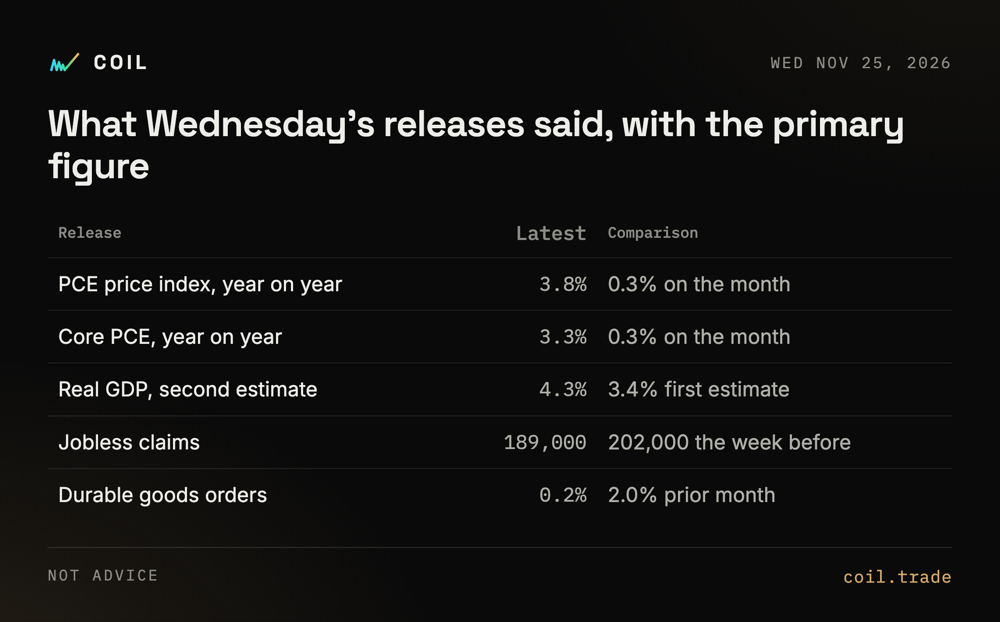
Put together, the morning showed an economy growing quickly, with few new layoffs and inflation that has not cooled enough. Stocks outside the biggest growth names took that well. We think it is a harder mix for the expensive end of the market, which needs lower rates more than the rest does, though we can't tie any single stock's move to these reports.
Deere guided carefully for its coming fiscal year
Deere reported before the open. Fiscal fourth-quarter net income was 3.89 dollars a share, with income down 1% from a year earlier and net sales and revenues down 2%. For the coming fiscal year the company forecasts net income of 4.50 billion to 5.25 billion dollars, against 4.86 billion dollars in the year just ended. That range straddles last year's result, so the company isn't promising a turn. The industrials fund still finished +0.83%. We have no consensus from a primary source to set against these figures.
Kanzhun and GDS were also on the board's calendar for Wednesday. We could not confirm either release from a primary source, so we leave their results out.
The book: bonds out, a new mix of stocks and real estate in
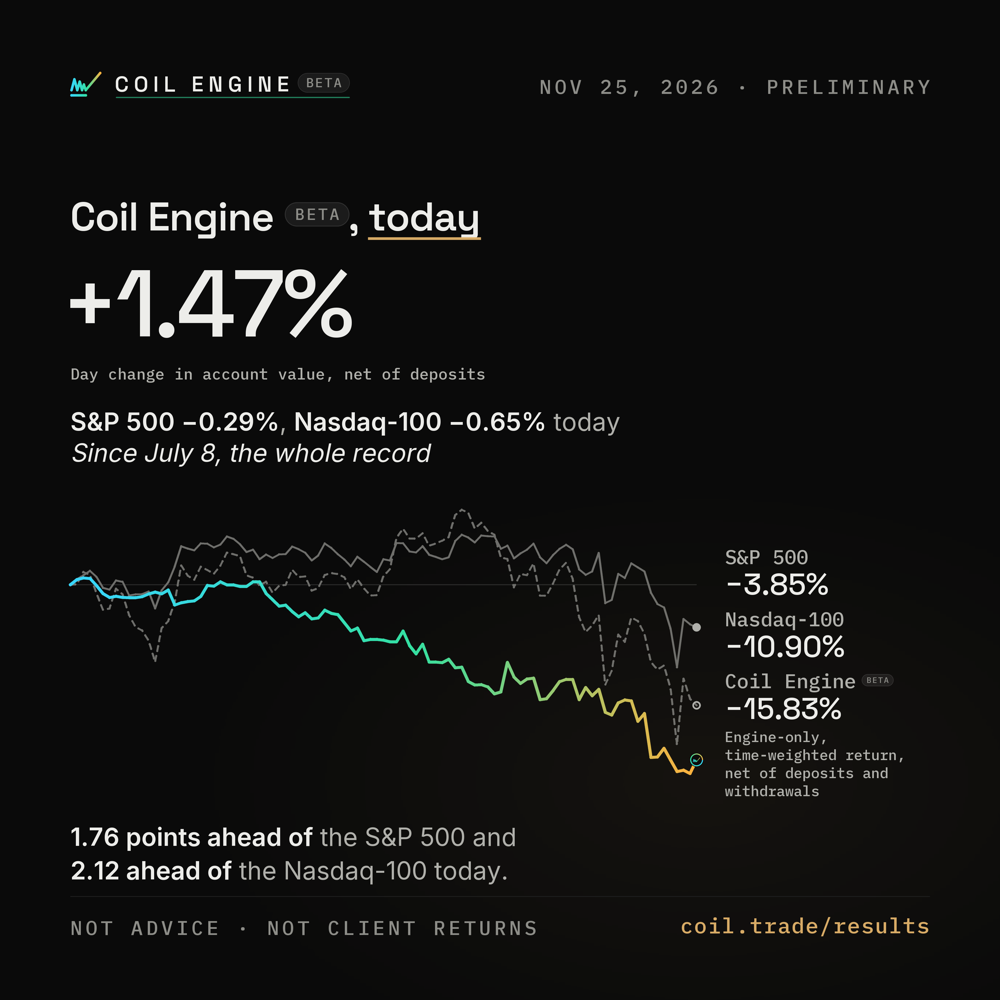
Coil Engine beta, Wednesday Nov 25: +1.47%. S&P 500 (SPY): −0.29%. Nasdaq-100 (QQQ): −0.65%. Today's figure is preliminary until tonight's settle.
Since July 8, 2026, through Nov 24: Coil Engine beta −17.05%, SPY −3.57%, QQQ −10.31%. Engine-only, time-weighted return, net of deposits. Two down sessions held flat and one hand-placed trade removed: see /results.
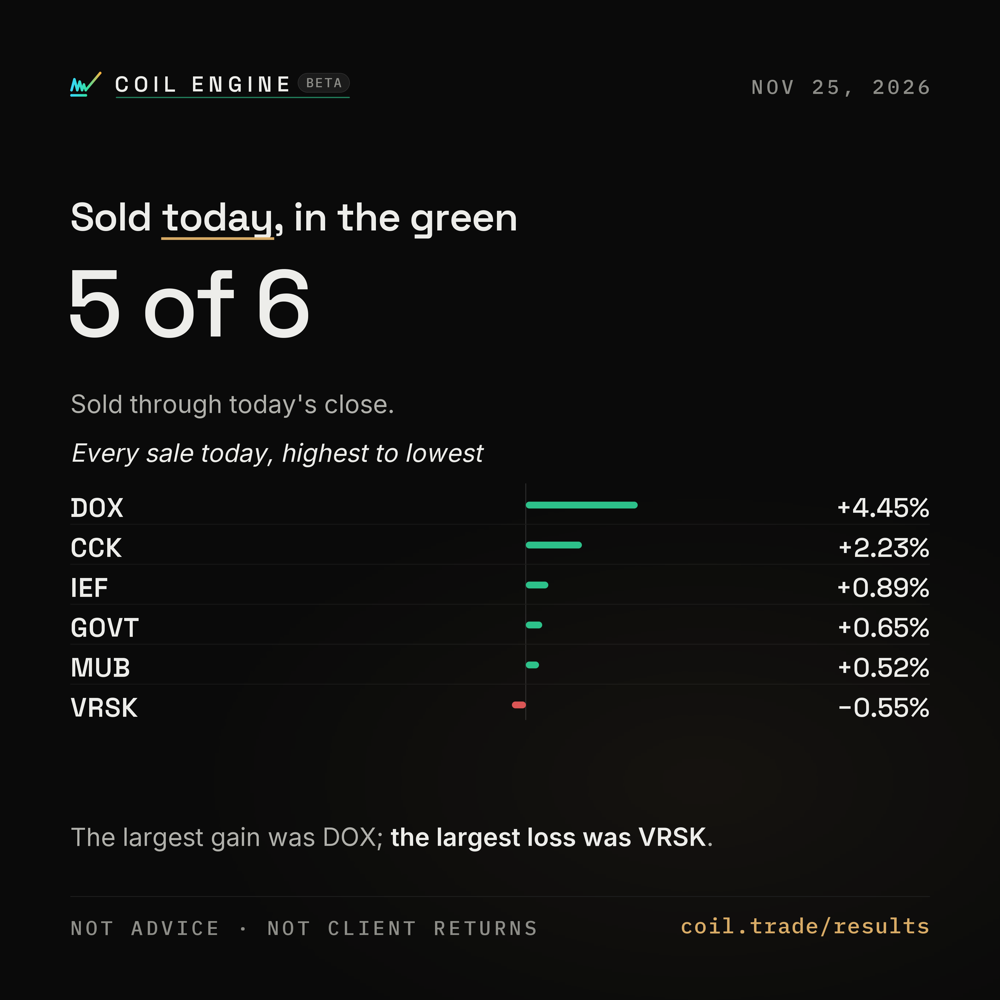
Six positions were closed. DOX paid the most at +4.45%, followed by CCK at +2.23%. The three bond funds, IEF, GOVT and MUB, went out at +0.89%, +0.65% and +0.52%.
We carry NTES, VNQ, Berkshire Hathaway, OGE, D and TW, and the rest is cash.
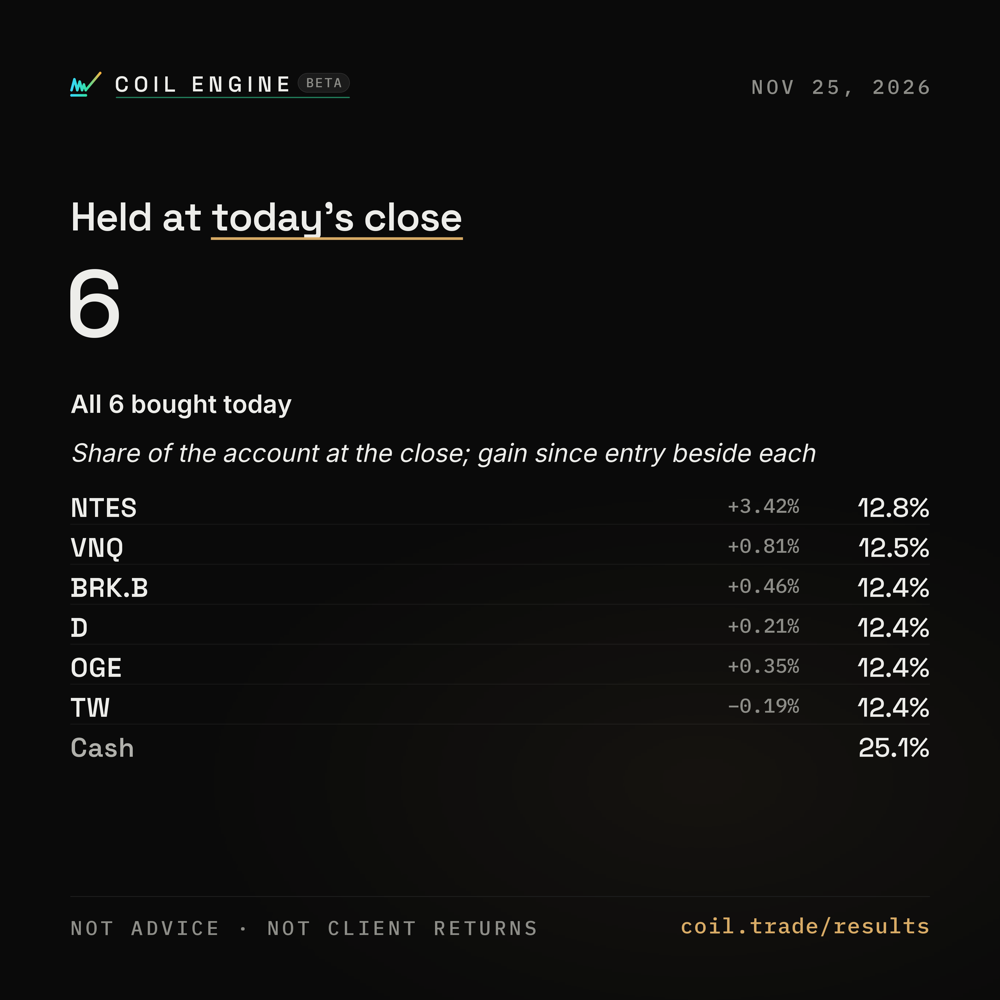
Verisk was the miss, closed at -0.55%. It is a small loss beside the winners, and it still counts. All six holdings are new, so none of them has proved anything yet.
Our call: QQQ stays heavy into Friday
Plenty of people will look at a green equal-weight fund and call the pullback healthy, a rotation that leaves the indexes ready to turn. Part of that is right, because breadth was strong. Our difference is about QQQ, which closed 633.93, sits −10.52% from its 50-day and has dropped −3.88% in five sessions. Its heaviest names are still the ones being sold, and a broad advance in smaller weights can't carry it far.
We think QQQ closes below today's close of 633.93 on Friday, November 27.
What would prove us wrong: a QQQ close above today's close on Friday, November 27. The call we made on Tuesday against that day's close is still open as well.
The first case against us is how close QQQ already is to the line, where a single firm morning in the chip heavyweights could flip the result. The second is the calendar, since a short, thinly traded session after a holiday can move an index on very little.
Our engine's market gate reads index only for both the S&P 500 and the Nasdaq-100. Each is in a downtrend below its 200-day and under its 55-day, so the index itself has an entry while the sector groups beneath it stay shut. Strength sits with staples, dividend payers, utilities, health care and long Treasuries. Money has left technology, gold miners, industrial metals and uranium. The gate agrees with the crowd that the move is defensive, and it declines to call the rotation a recovery.
Today's trading fits that picture only partly. We moved out of bond funds even as bonds sit among the stronger groups, and the new positions are individual names plus a real estate fund, none of them an index, which reaches past a plain index-only read. What would change the gate is either index getting back above its 55-day inside an intact trend, and that is what we're watching.
An AI agent can pull this gate, the sector map and the names sitting at an entry by connecting to Coil over MCP, or pay for a single read through x402, starting at coil.trade/connect.
What's next
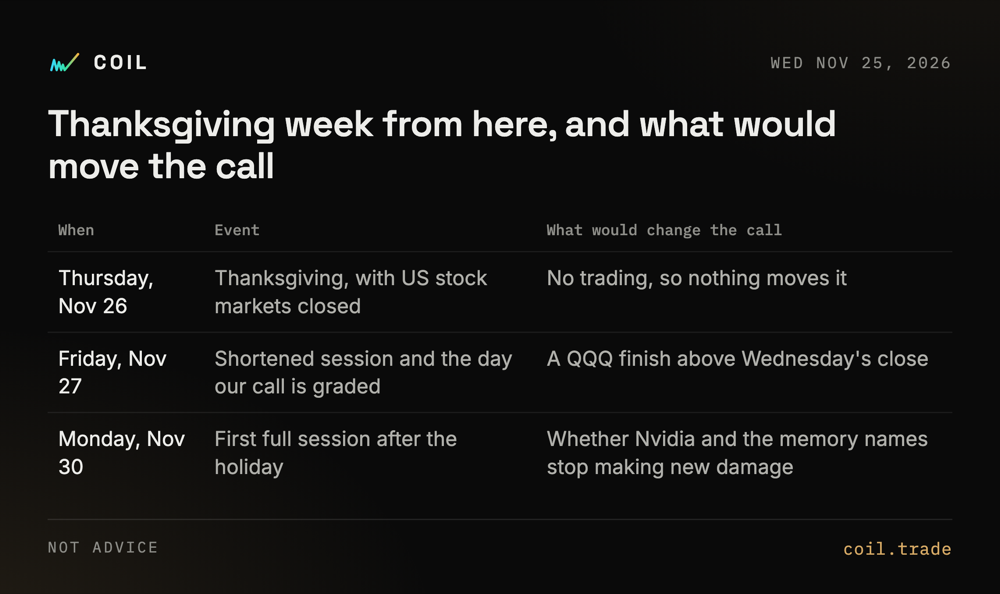
Friday is thin, and we'd treat a sharp move in either direction with some suspicion until full volume returns.
If a morning read before the open would help through the holiday stretch, the free Brief list is at coil.trade/brief.
Our full record is at coil.trade/results.
Not advice.
COIL CLOSE is impersonal market commentary. It states a dated view of a market instrument, graded against its stated test, and is not investment advice, a recommendation or an instruction to trade, and is not tailored to anyone’s circumstances. Figures and prices are as of the time stated above.