The midterm result moved money from AI site builders to those paying them
Published Nov 4, 2026, 2:00 PM PT. Figures and prices are as of that date; the current record is at /results.

Prices as of 1:54 PM Pacific. Regular-session figures are Wednesday's 1:00 PM Pacific close; anything marked after hours is the extended session at that time.
Money left nearly everything tied to the AI build on Wednesday and went almost everywhere else, and reporting ties the move to the midterm result and what it may mean for data-center permits. We sorted 624 stocks on our board by sensitivity to chips: the fifth most sensitive had a median move of −3.66% and the other 500 a median of +3.05%. We think the market charged site builders for a slowdown it has charged to the chip fund much less. We still think SMH closes below 518.25 on Friday, with the fund at 504.48 tonight, and our book lagged an up day after buying energy and technology into the selling.
The tape
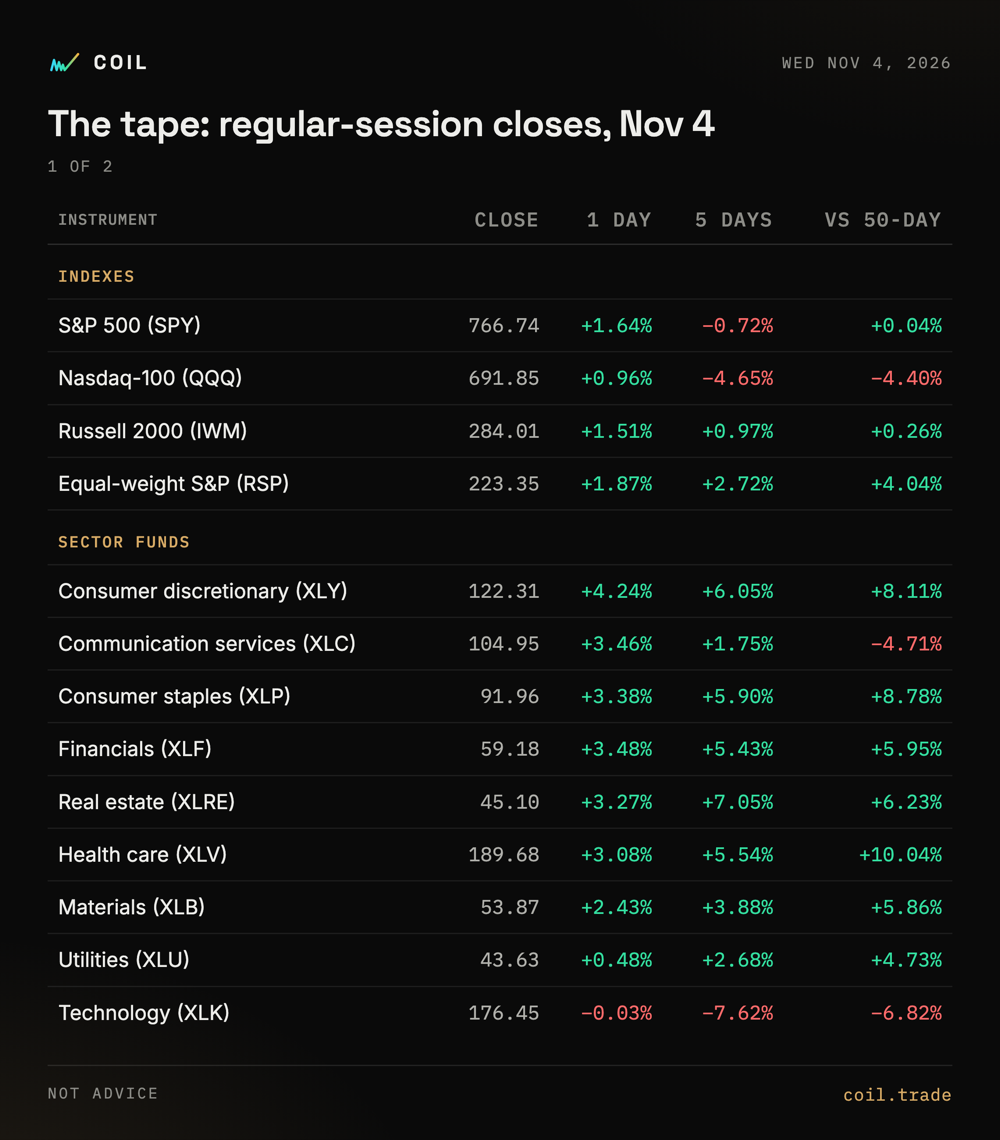
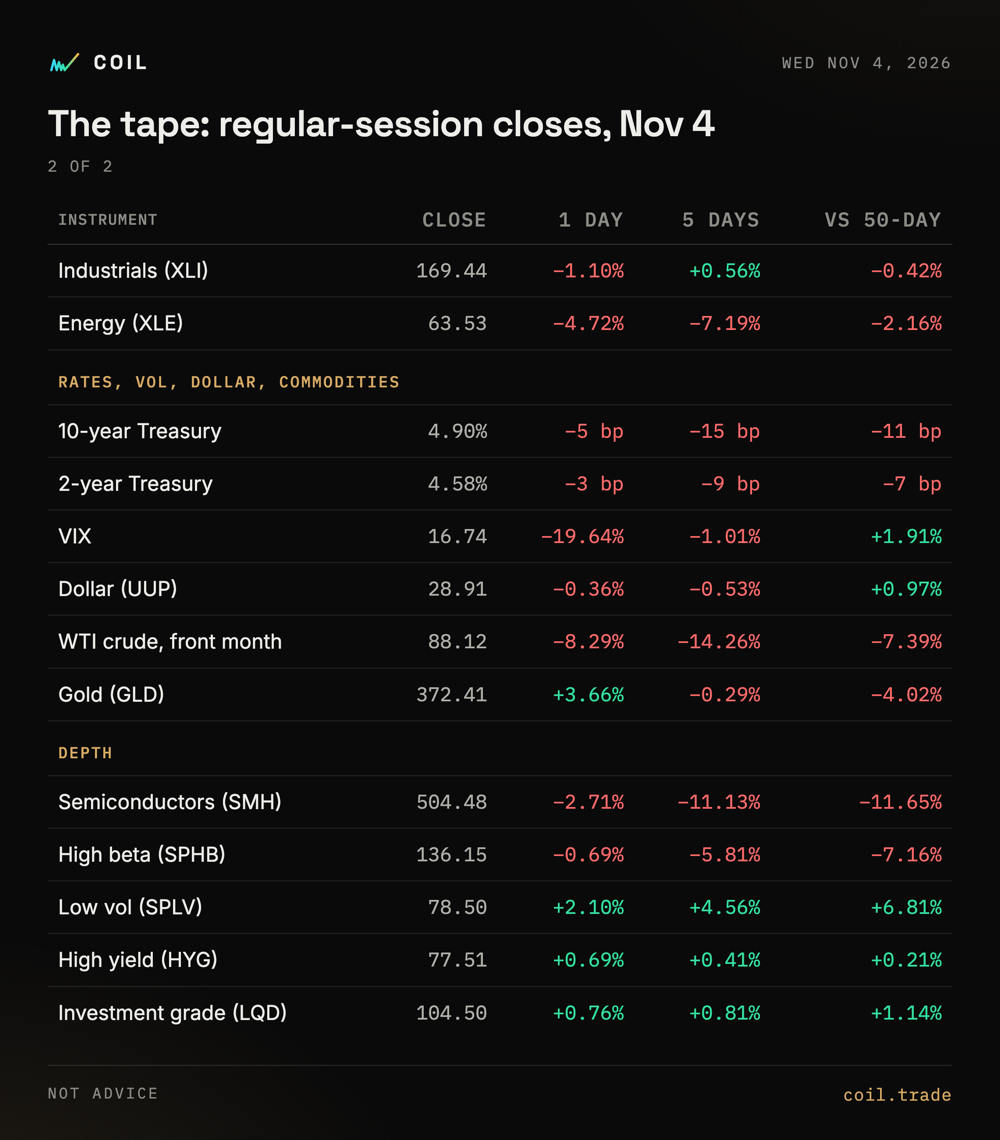
Regular-session closes, Nov 4. The 5-day column starts from the Oct 28 close. Treasury yields are par rates, in basis points, with distance measured against their 50-day mean.
What changed since Tuesday's close
- Data-center limits are now a priced risk. Reporting ties the selloff in data-center stocks to the midterm result and its effect on state and local permitting. Texas holds about 27% of planned US data-center gigawatts on one sell-side count, and another sell-side estimate puts about 45% of planned US capacity in states it expects to add restrictions. That is exposure, not capacity lost, and we expect permits to come up on AI suppliers' next calls.
- WTI closed −8.29% at 88.12, its lowest in four weeks, even though the EIA reported a 0.9 million barrel draw in commercial crude against one public estimate of a 0.9 million barrel build. We can't source one cause. One report links the drop to the midterm result adding pressure to end the Iran war and says the immediate trigger remains unclear; Monday's fall came on talks. The ISM chair said fuel and tariff costs were what respondents cited most, so we think cheaper crude eases some price pressure and with it some pressure on yields.
- Wednesday's scheduled macro leaned against our call. Treasury held the refunding at 125 billion dollars with the same coupon sizes as August, and ISM services prices eased to 73.0 from 74.0 against forecasts of 74.6 and 75.0, while new orders fell 3.9 points. Only ADP ran hot, at 86,000 against forecasts of 67,000 to 75,000 (press reports of the release). We said Tuesday that larger coupons or hotter prices would support the call, and neither arrived.
Sensitivity to chips sorted Wednesday's winners from its losers
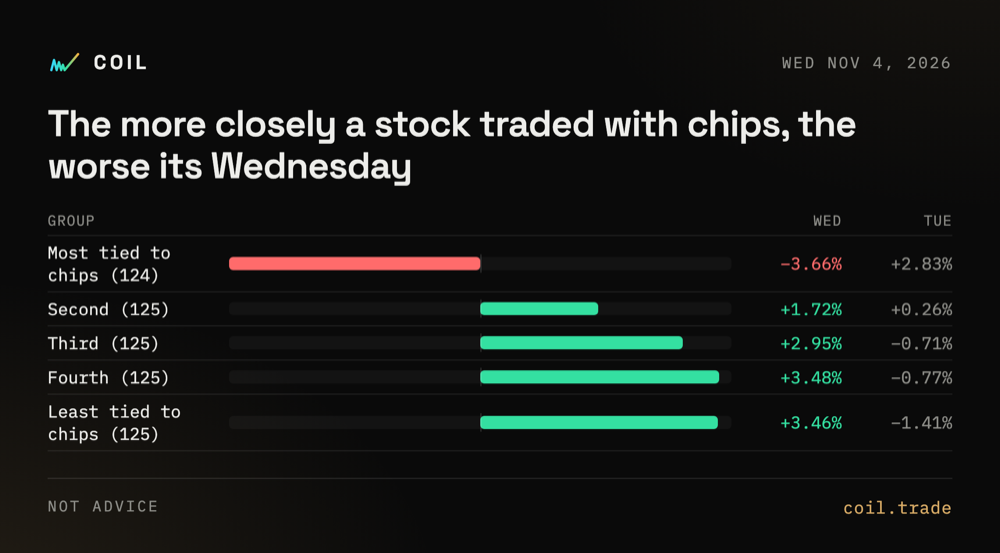
We sorted 624 stocks on our board by their beta to SMH over the 60 sessions through Tuesday, a measure of how hard each moves when the fund moves, and cut them into five groups. The 124 most sensitive had a median move of −3.66%, and 29 of them rose. The other 500 had a median of +3.05%, and 417 rose. Beta and the day's move have a correlation of −0.54, and the medians climb from the most sensitive group through the fourth, then level off. 38 of the 50 worst stocks came from the top fifth, where chance would put about 10.
Tuesday ran the other way. The same top group had a median gain of 2.83% and the bottom group lost 1.41%, the reversal we described in yesterday's Article. We think part of Wednesday is that bounce paying back.
RSP closed +1.87% against +1.64% for SPY, so this was a broad advance and the megacaps were not carrying it. Inside the sectors it split. The 15 Industrials with the highest chip beta had a median of −9.58%, while the other 80 in the group had a median of +1.62%. The four power producers most tied to chips had a median of −11.03%, against +1.63% for the 28 other utilities. High beta (SPHB) closed −0.69% and low vol (SPLV) +2.10% on a day SPY rose. A bounce unwinding would not explain moves that size inside Industrials and Utilities, so we read the sorting as exposure to the build and not only yesterday's reversal.
Texas already had a permit pause before the vote, which changes how we read the result. A Sept 21 state directive told its environmental regulator to halt data-center permits until a grid review is finished, and law-firm notes put the end of that review between Dec 10 and mid-December. We could not confirm today's status of the pause beyond those September notes. One report says New York has had a statewide moratorium on new hyperscale sites since July, for up to a year, and we found no second source. Wednesday created neither one. We think what changed is the assumption that such limits end on schedule, and the December review is when that gets tested.
The spenders rose, and SMH fell less than the typical chip stock
Microsoft closed +6.72% and Amazon +6.16%, and we found no company news behind either. Reporting ties the gains to a bet that slower construction makes existing data centers more valuable and limits what these companies spend. That is one strategist's explanation, and we can't test it. The funding worry predates the vote. Amazon's own release shows trailing free cash flow of −42.4 billion dollars after a 94.8 billion dollars year-over-year rise in purchases of property and equipment, with about 220 billion dollars of cash capex expected this year, and SMH lost 7.0% on Oct 30 when that report and Intel's guide landed. We think that is why the prospect of lower spending lifted the spenders.
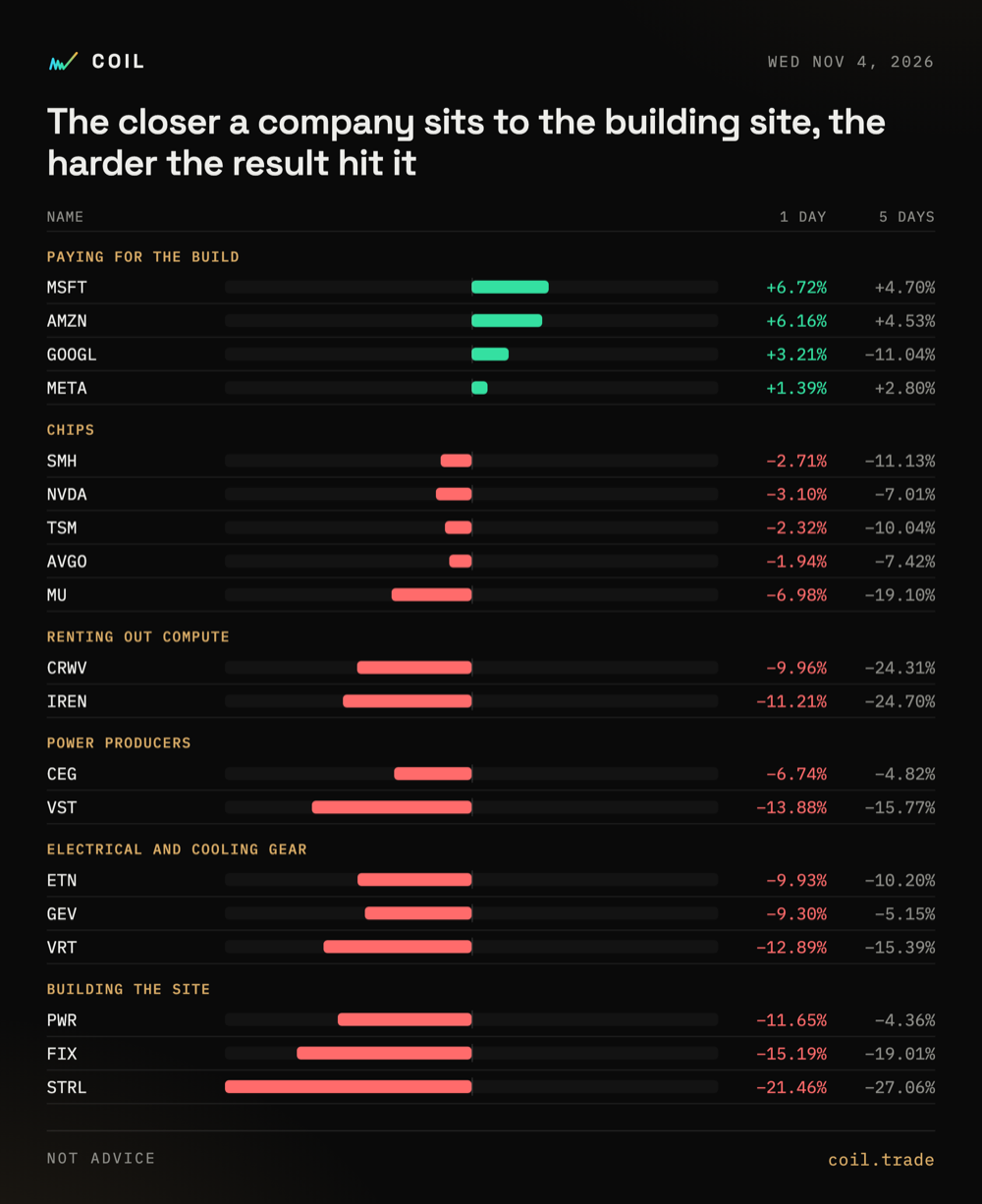
The order of the damage makes sense to us, though it is our reasoning and not something we could source. A permit pause stops a shell and its power hookup first, and chips go in last, so the companies that pour, wire and cool the site lose first. Chips can also move to sites that already have power, and AMD said on Tuesday that demand exceeds what it can ship. One report's own estimate has projects without environmental permits slipping 12 to 18 months while those with power, permits and construction underway proceed.
Where we part from the tape is the size of the gap. If the spenders' gains are right and their bills shrink, AMD's growth of more than 80% in 2027 and the estimates built on it are too high. If chips are right that little changes, the site builders' losses and the spenders' gains are both too large. SMH's −2.71% sits closer to the second view, and it flatters the group: the median of the 35 chip and optical stocks we track was −4.11%, with 3 up, while Nvidia, the fund's largest weight at 19.6%, closed −3.10%. We lean toward the spenders' view this week. The typical chip stock fell by more than the fund, and we expect the fund to close that gap.
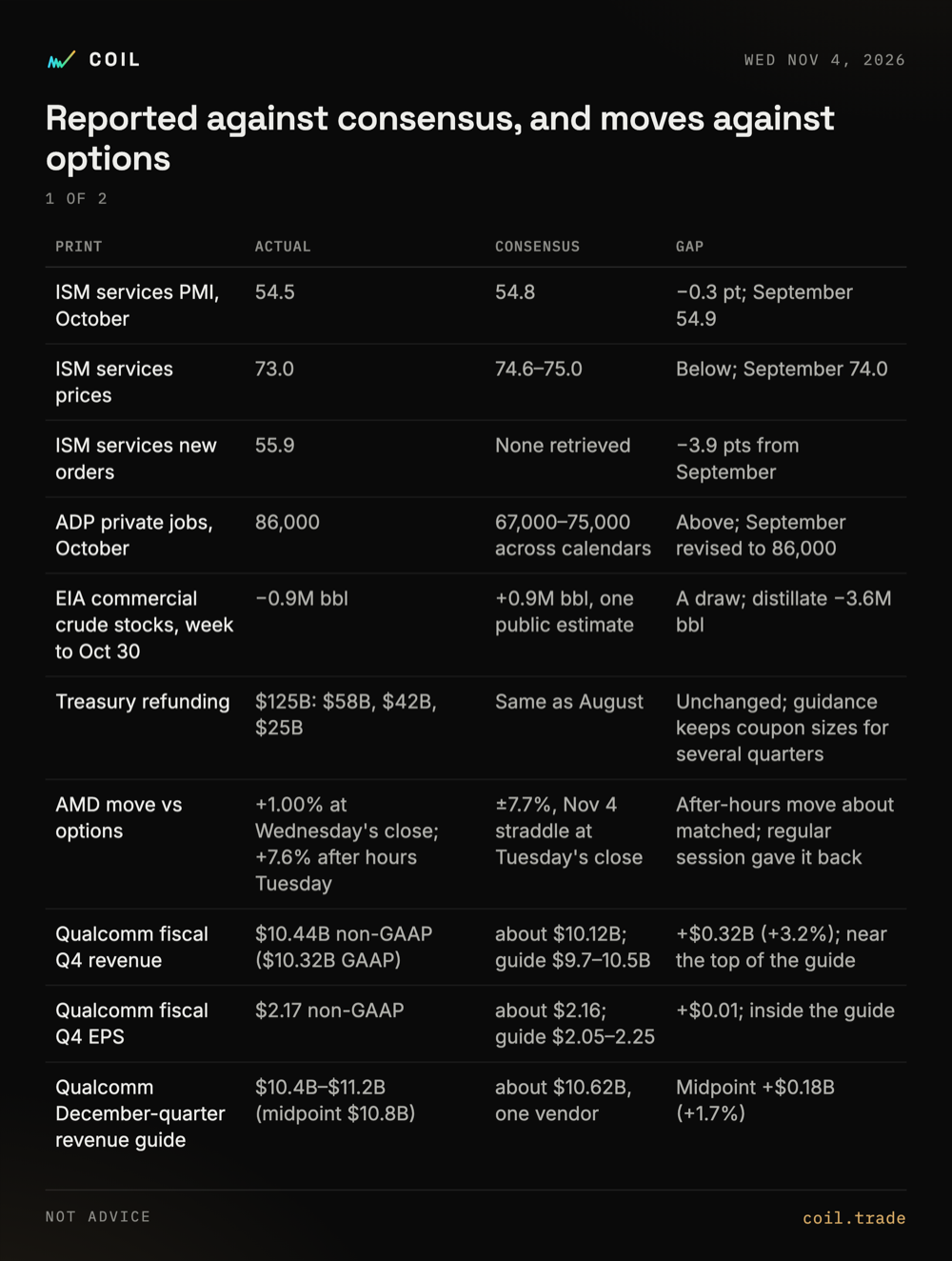
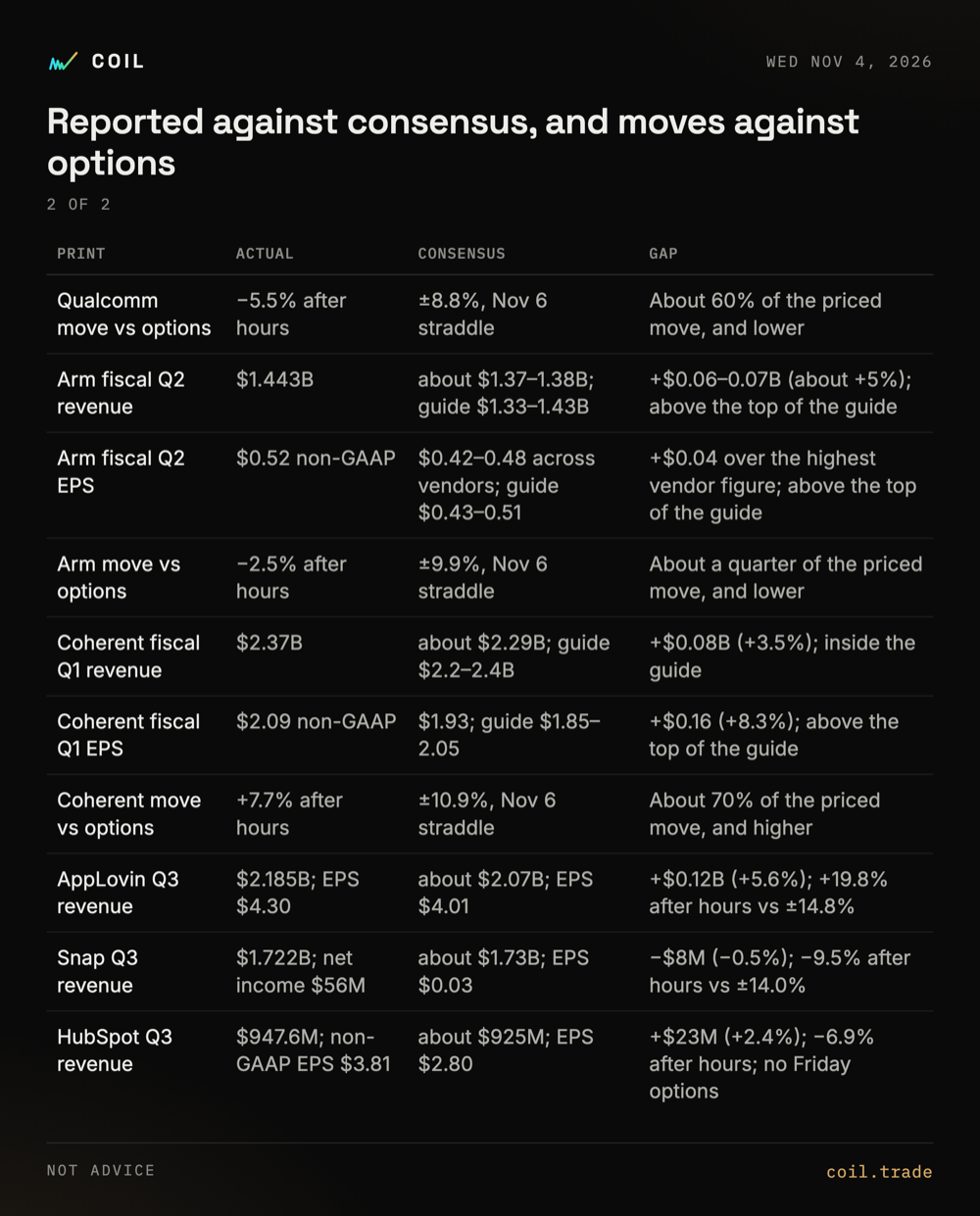
Estimates retrieved Nov 4, 2026 from public reports of data-vendor estimates; figures differ by vendor. Straddles are the last regular-session marks at the strike nearest the stock.
AMD is the cleanest test of what good news buys now. Options priced about 7.7% through today's expiry, and the stock traded 7.6% above Tuesday's close at 3:26 PM Pacific after its guide. It closed Wednesday +1.00%. We called the demand argument finished on Tuesday and we still do. The open question is whether the sites to house that demand arrive on the schedule the estimates assume.
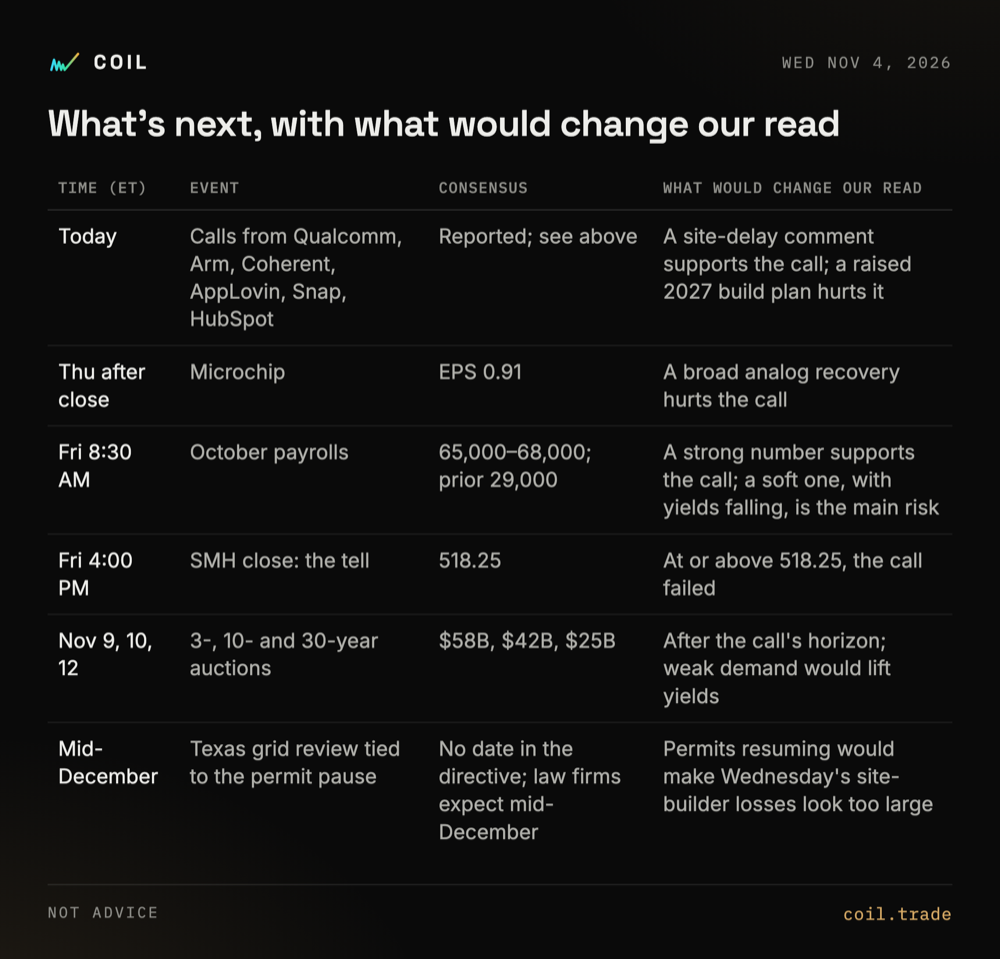
Qualcomm, Arm and Coherent reported after the close, against Friday straddles pricing moves of about 8.8%, 9.9% and 10.9%. Coherent sits in the part of the chain the market sold today and closed at −5.94%. Qualcomm closed at +5.66% and Arm at −5.04%, both nearer phones and Tuesday's memory-cost worry. Qualcomm, Arm and Coherent all beat on revenue, and none moved after hours as far as its straddle priced. Qualcomm and Arm are lower, with handsets the drag at Qualcomm. Coherent is up 7.7%, more than the 5.94% it lost in the session, the one chip report that bought back Wednesday's selling. AppLovin, outside the chip chain, moved more than its straddle priced. SMH is up 0.29% after hours at 505.95, still under our line, so we read that as no reason to change the call, and payrolls on Friday is the larger test.
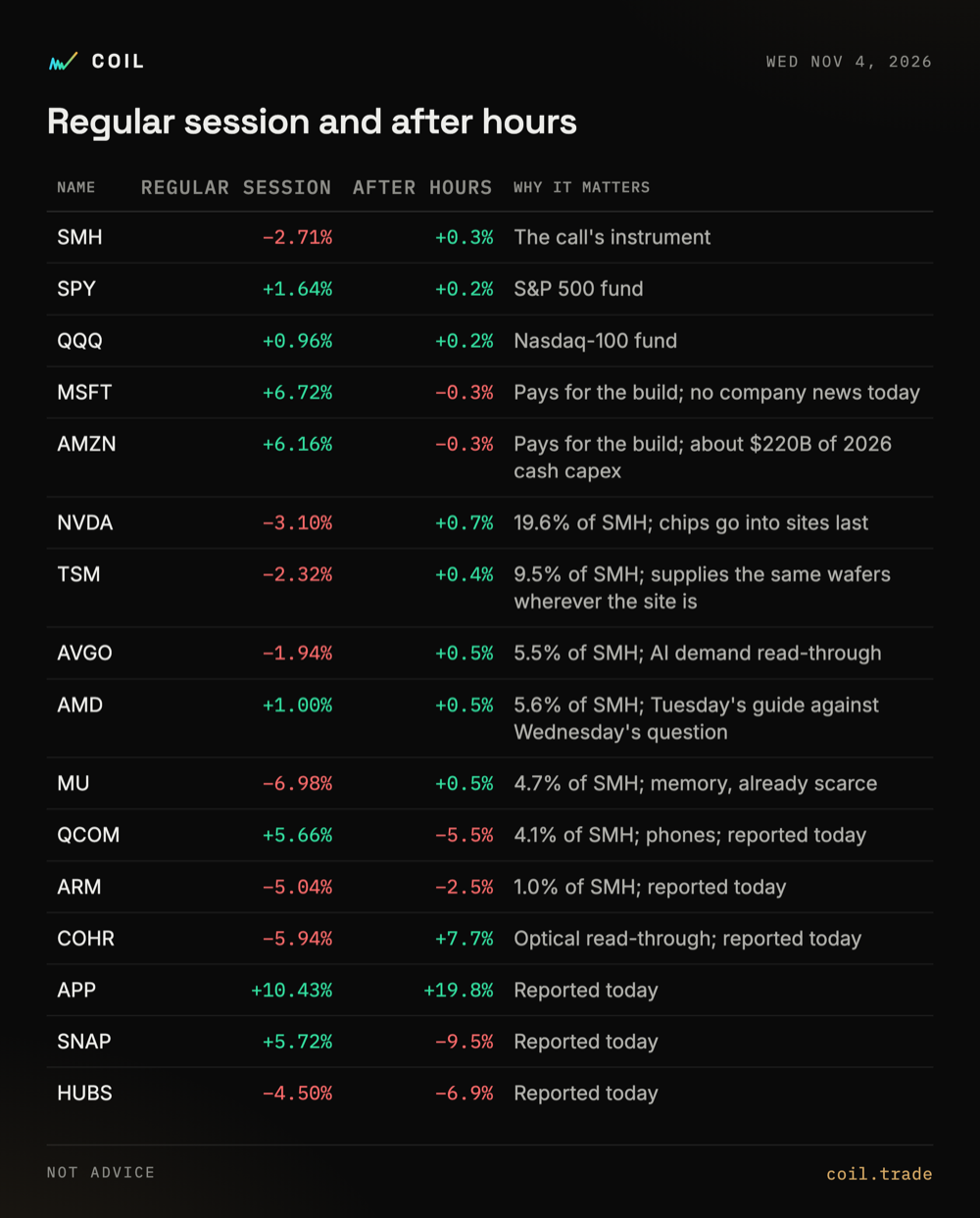
The after-hours column runs from the regular close to the stamp above. Fund weights are dated Oct 30.
We took what the day was selling
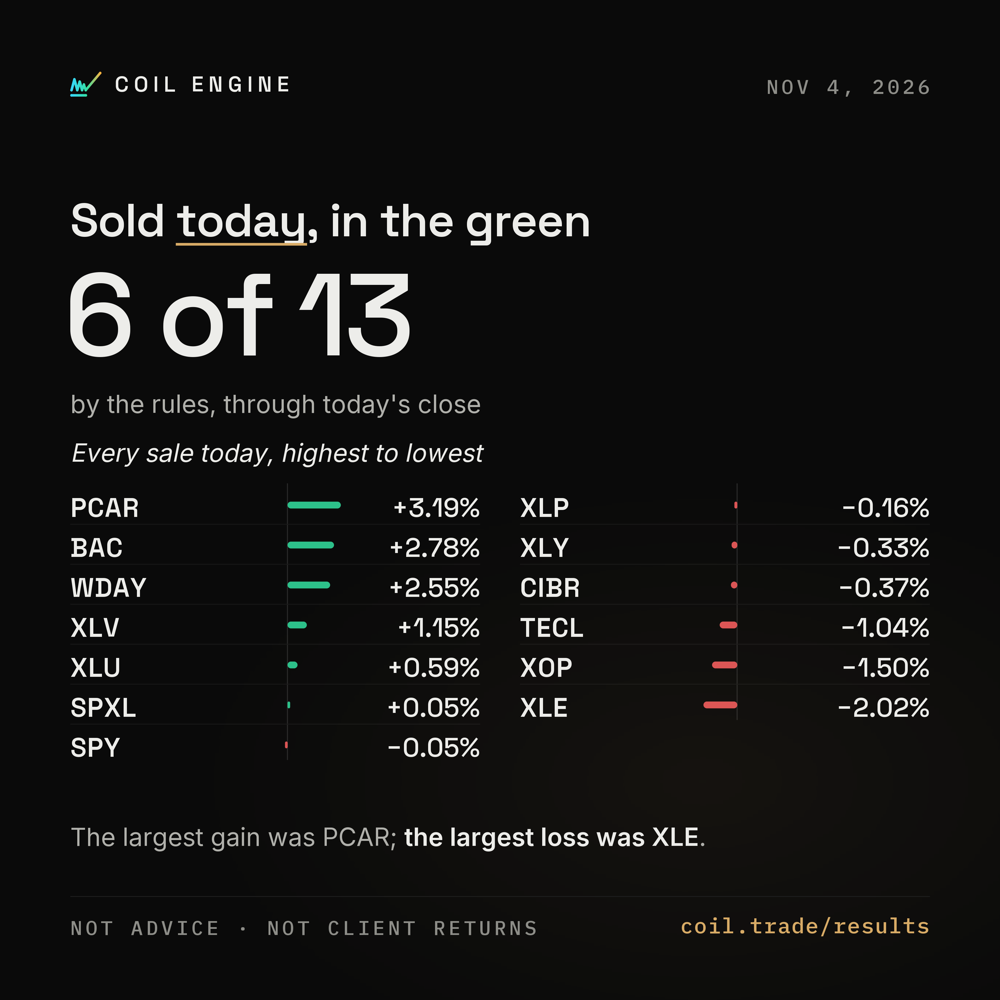
We took energy and leveraged technology into the selling, and those were the wrong trades. XOP and XLE were down 3.9% and 3.7% when we took them at 185.03 and 64.50, on a day oil kept falling. We sold XOP at 182.25 as it slid further. We sold XLE at 63.19 because energy had broken, with 2 of its 68 members up. That cost 1.50% and 2.02% of those positions. XOP closed at 179.29 and XLE at 63.53. We then took TECL, a 3x technology fund, at 166.54 with the fund down 7%, sold it at 164.80 and moved into XLRE at 44.98 because technology was the weakest sector. The argument at the top of this note describes that selling; we stood in front of it.
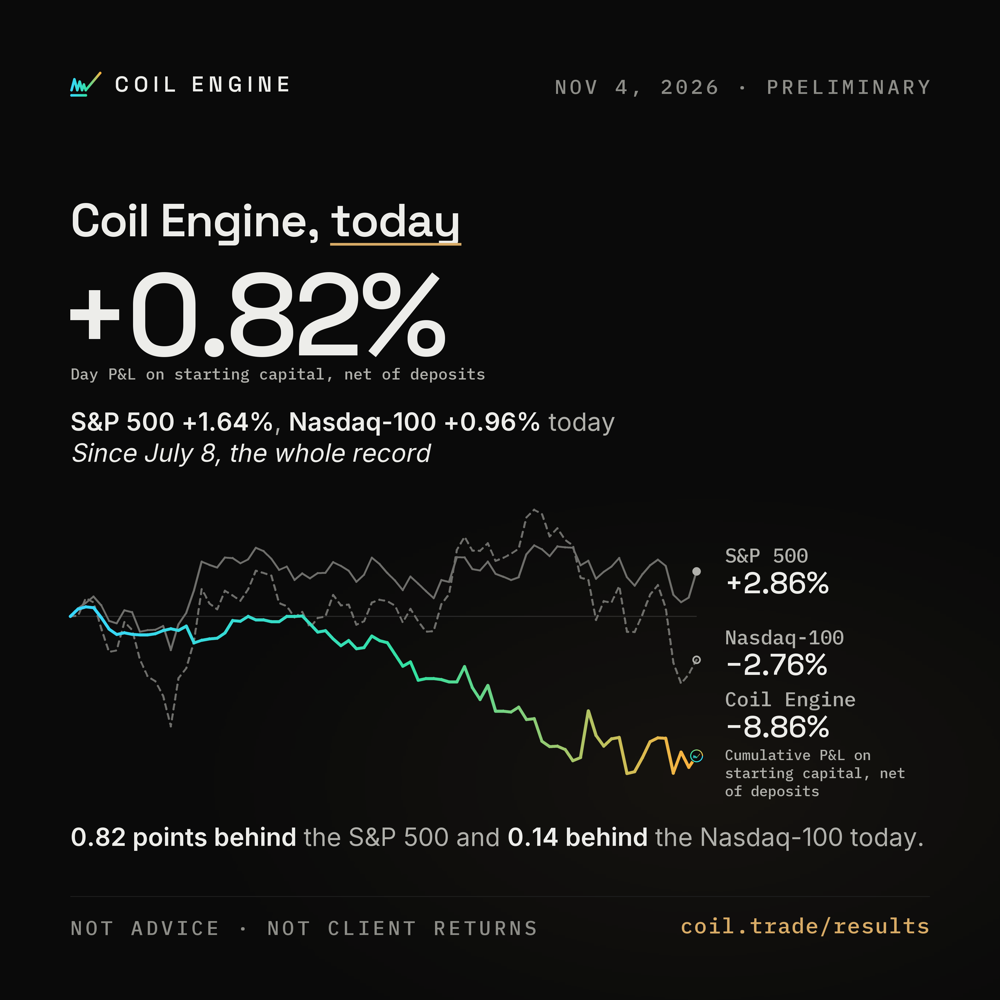
Where the day went: the account made nearly all of its gain in the first three minutes, on what it already held, with 56% of it in cash. SPY was up 1.76% by 7:08 AM and closed up 1.64%, so that opening cash accounts for most of the gap to SPY. Every trade after that, the energy losses and the winners together, netted about zero: the session's decisions did not pay for themselves.
We also chased the rally after it had happened. SPY was up 1.76% when we took it at 767.59, and it closed at 766.74. XLP and XLY were up 3.9% and 4.8% when we took them. We closed SPY, SPXL, XLP, XLU and XLY before the bell at about what we paid, because none had room left under its high to hold overnight.
What worked was what we already owned or got cheaply. Bank of America, bought Tuesday at 49.70, went for 51.22 and 51.03; it closed about 1% above both, at 51.63. PACCAR, bought 10% under its 50-day at 102.82, went for 106.13 and 106.09 and closed at 106.17. Workday, bought Tuesday at 199.16, went partly at 208.03 ahead of AppLovin's report and the rest at 202.97; it closed at 201.85, 3% under the first sale. We sold XLV too soon, at 187.91 and 186.24, on a day it closed at 189.68.
The energy buys cost about half a percent of the account, and they came from an automatic sector buy into names still making new lows. That buy now waits until a name stops making them. We will report whether that wait earned its place once it has 20 refusals or by November 27, whichever comes first. One day proves nothing either way, and we remain behind the index since July.
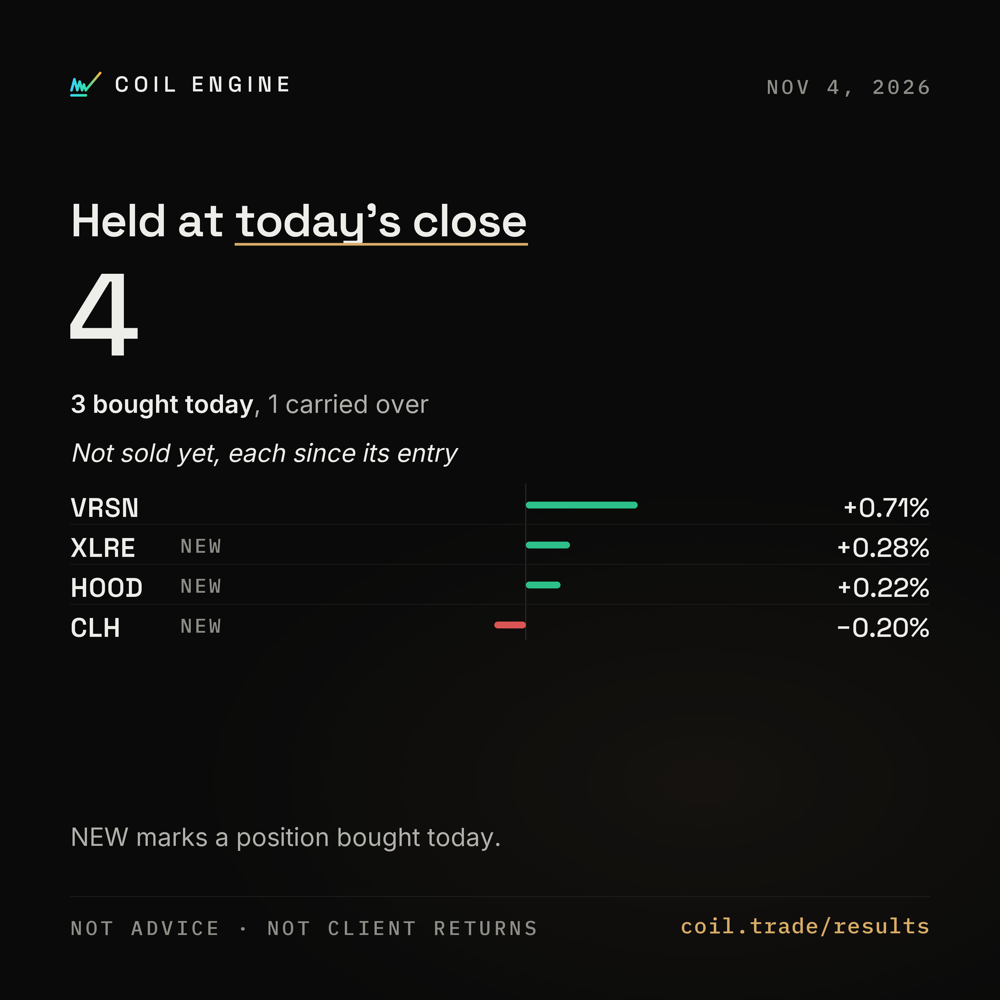
We carry Clean Harbors, Robinhood, VeriSign and XLRE, and the rest is cash.
Our call: SMH still closes below 518.25 on Friday
The common read of Wednesday is relief: the midterm event risk is gone, breadth is strong and the VIX fell to 16.74. We agree on the breadth. We differ on chips. Investors just paid the largest AI spenders for the prospect of spending less, which is bad news for their suppliers, and left the fund that holds those suppliers at −2.71%, with payrolls on Friday still to come.
We think SMH closes below its Tuesday close of 518.25 on Friday, November 6. Its horizon is Friday's close, and the tell is SMH closing Friday at or above 518.25. The call stands. SMH moved −2.71% today to 504.48, and the Friday straddle prices about 3.0% of the fund. We made this call on margins, memory and funding, and Tuesday's table said a clean midterm count would work against it. Wednesday's fall, which reporting ties to the midterm result, came from a reason we didn't have, and we take no credit for it.
We can be wrong in two ways. Some analysts doubt legislation could meaningfully halt construction, one analyst's worst case in a TV segment reported Nov 3 was only about 9% of planned AI capacity, and chips can go where the power is, so this can fade by Friday as fast as it arrived. SMH rose 2% on Tuesday alone, and it needs 2.7% to reach our line.
The second is rates. Oil's fall and softer ISM prices already lean toward lower yields, with the 10-year at 4.90%. Forecasts for payrolls sit near 65,000-68,000 after 29,000, and a soft number would ease the funding worry we lean on and break this call.
The book holds no chip stock and no fund heavy in chips, so nothing we own moves directly on this call.
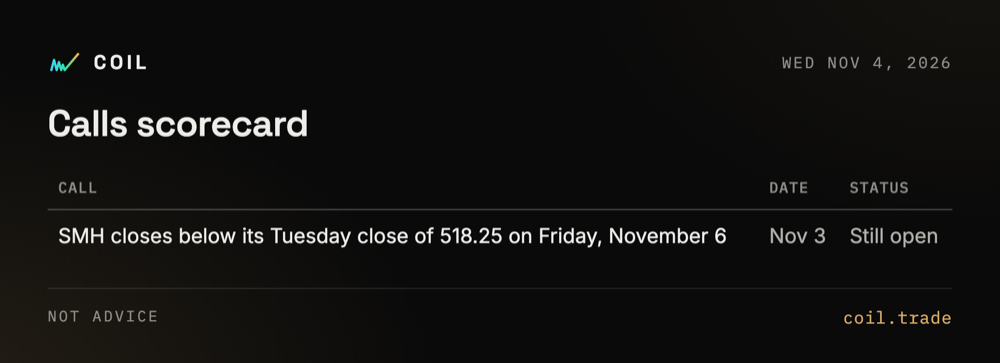
One call open, none graded, dated Nov 3.
What's next
Correction to the Nov 3 Article
The settled record through Nov 3 differs from the Article's figures, which were read from the 1:47 PM Pacific close pull. Cumulative P&L on starting capital, net of deposits, since July 8: −9.60% settled against the Article's −9.62% (SPY +1.20% against +1.21%; QQQ −3.68% against −3.67%). Day P&L on starting capital, net of deposits, Nov 3: −1.06% settled against the Article's −1.08% (SPY +0.30% against +0.31%; QQQ +0.62%, unchanged). SMH's official Tuesday close was 518.52; our call was written at 518.25, the last price we had, and we will grade it against 518.25 as written.
Our full record is at coil.trade/results.
Not advice.
COIL CLOSE is impersonal market commentary. It states a dated view of a market instrument, graded against its stated test, and is not investment advice, a recommendation or an instruction to trade, and is not tailored to anyone’s circumstances. Figures and prices are as of the time stated above.