AMD settled the demand debate. Chips fell over supply and cash
Published Nov 3, 2026, 4:32 PM PT. Figures and prices are as of that date; the current record is at /results.

Prices as of 4:28 PM Pacific. Regular-session figures are Tuesday's 1:00 PM Pacific close; anything marked after hours is the extended session at that time.
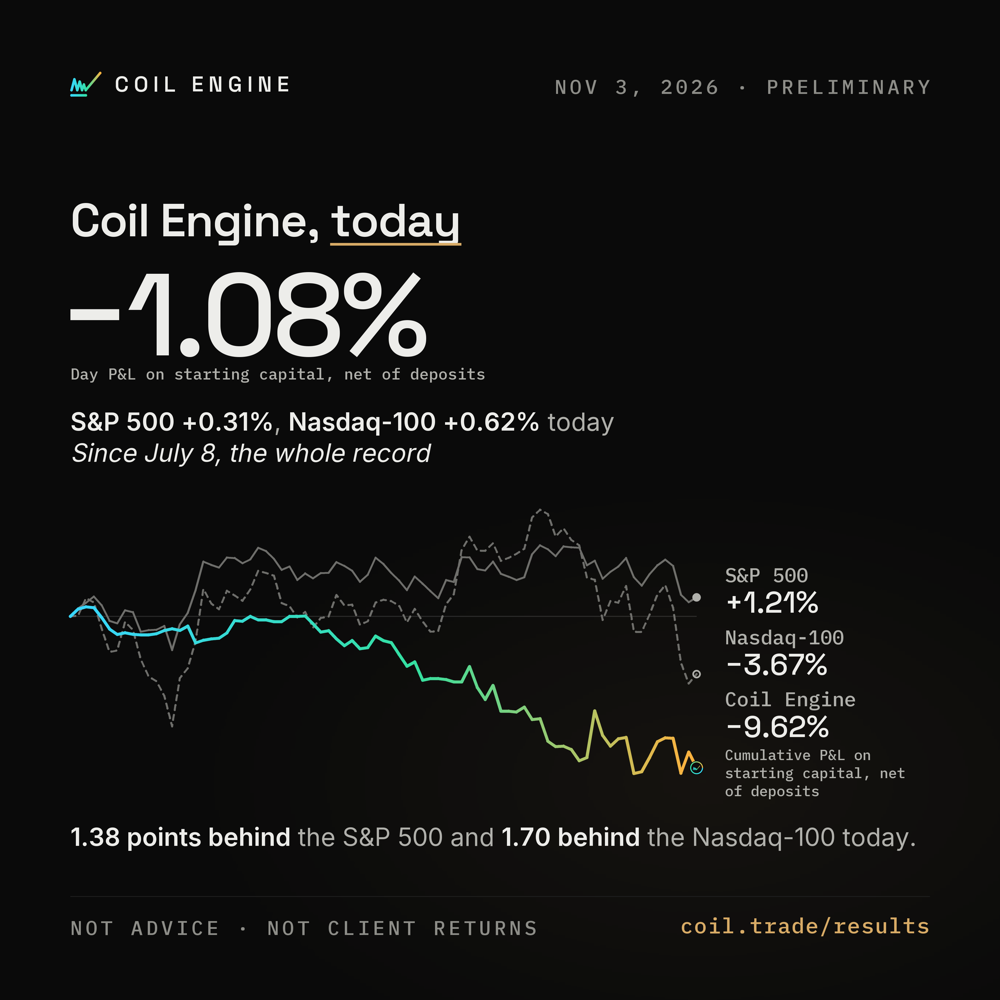
AMD guided about 5% above consensus after the close and told its call that 2027 revenue grows more than 80%, so we think the argument over AI demand is finished. SMH's 18% fall from its Oct 5 close came from worries about supply and about who pays for the build, and on those two AMD offered less comfort than its headline. We think SMH closes below Tuesday's 518.25 on Friday, a harder call tonight with the fund near 517 after hours, and our book closed fifteen trades, ten of them red, after paying up on a day that punished it.
The tape
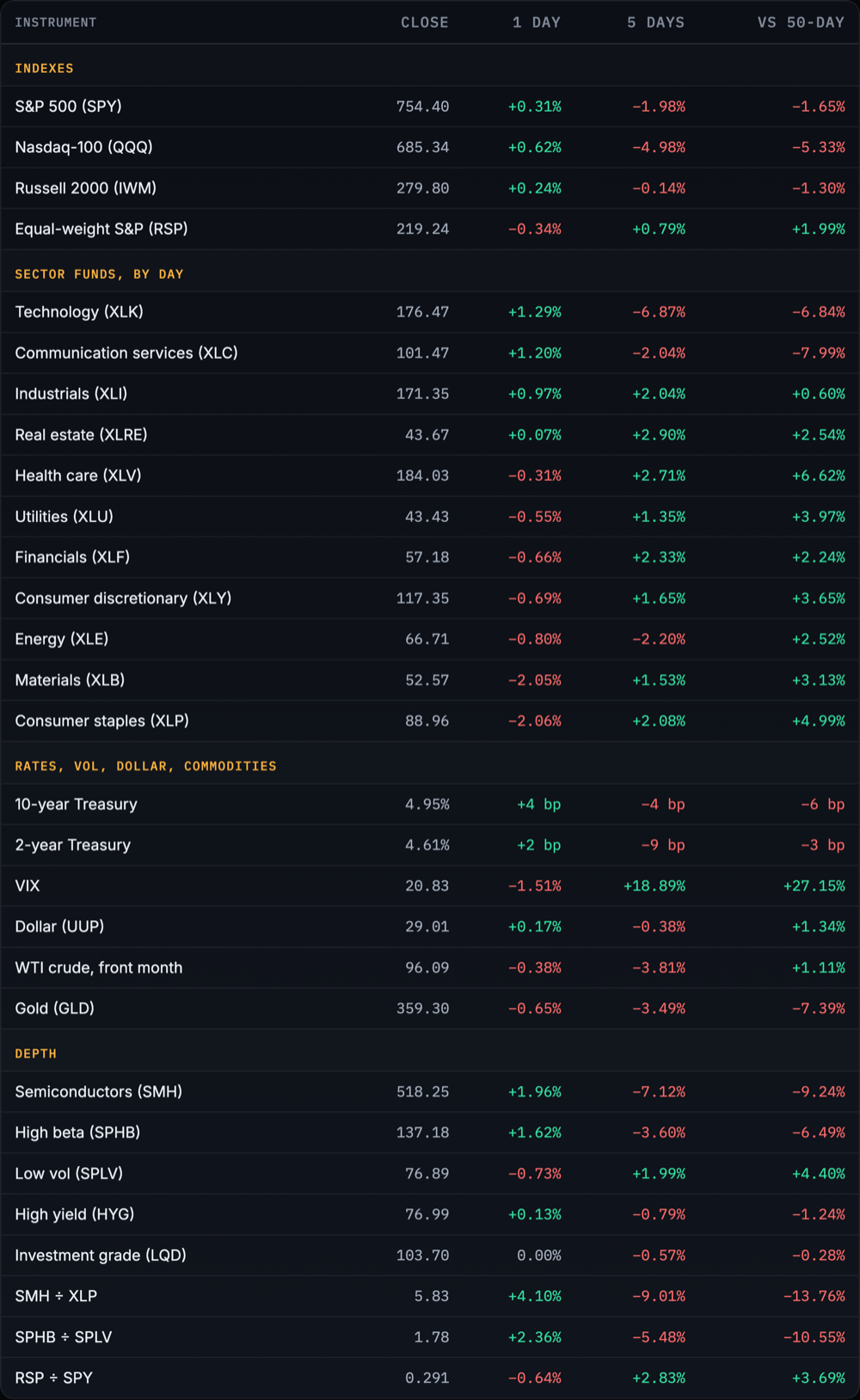
Regular-session closes, Nov 3. 5 days runs from the Oct 27 close. Yields are Treasury par rates, in basis points; distance from the 50-day for yields is against the 50-day mean.
What changed since Monday's close
- AMD raised the ceiling. Management now expects 2027 revenue growth above 80%, with server revenue doubling and data-center AI more than doubling. We expect estimates across AI suppliers to rise this week, and we think a bear case built on slowing demand is now much harder to argue.
- Arista jumped on a guide above Street estimates while Skyworks collapsed after guiding smartphone revenue lower, all in one evening. SMH holds chipmakers on both sides of that split, and its next two reports, Qualcomm and Arm on Wednesday, sit closer to phones than to racks.
- The BLS put quits at 3.4 million from 3.0 million, days after two FOMC voters dissented in favor of a hike, with the 2-year at 4.61% against a 3.75-4.00% target range. Friday's payrolls can now move rate expectations, and AI spending increasingly runs on borrowed money.
The print was big, and options had already charged for it
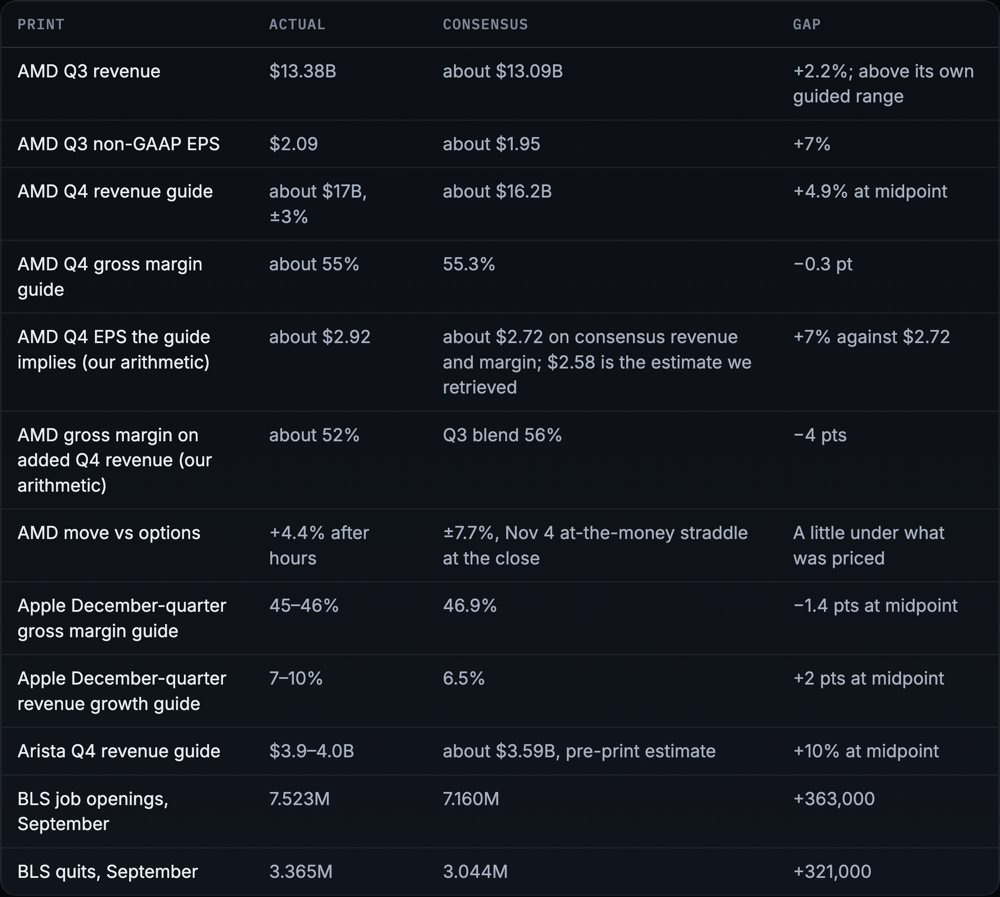
Consensus retrieved Nov 3, 2026 from public reports of data-vendor estimates; figures differ slightly by vendor. Options are the last regular-session marks.
Tuesday's close gave a clean read of what was expected. AMD's at-the-money straddle expiring Nov 4 was marked at about 7.7% of the stock, and the shares sit about 4.4% higher after hours. A revenue guide this far above consensus has earned a little less than the move options had priced, on top of the 3.8% the stock gained in the regular session before anyone saw a number. The sell side was never the obstacle either: AMD went into the print with 47 buy ratings, 10 holds and no sells, on a count last updated Oct 3.
The guide is better than the consensus line makes it look. Run AMD's Q4 slide through to the bottom and non-GAAP EPS comes to about 2.92 dollars. The 2.58 dollars estimate we retrieved looks stale, because consensus revenue and margin on the same costs produce about 2.72 dollars, so we put the true gap near 7%. The weak spot is the margin on the new dollars, about 52% on our arithmetic and four points under the Q3 blend. AMD's CFO called data-center AI a little dilutive to the corporate average, and said gross margin dollars are rising sharply. Super Micro's report, in the table below, shows the far end of that mix.
None of this makes our call easier, and the arithmetic is plain. At about 517 after hours, SMH has to fall about -0.3% and hold it through Friday's close. AMD's own 5.6% weight explains only about 0.2 points of the fund's after-hours gain. The rest is read-through into the group, the part we expect to fade.
What took chips down is still open, and the money went elsewhere
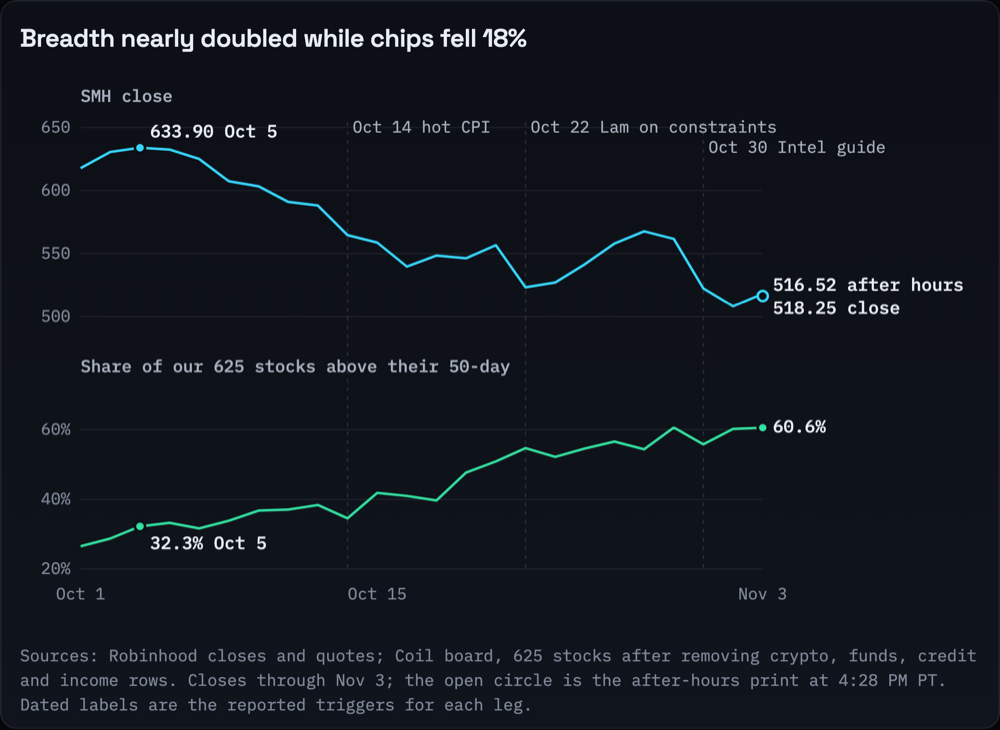
We dated each leg of the fall. A hot CPI on Oct 14 and a cautious TSMC call the next day turned attention to what the build costs to fund. Comments from Lam Research's chief executive that component constraints would keep limiting chipmakers into 2027 hit on Oct 22, and SMH lost 6.0% that day. Intel's guide and Amazon's shrinking free cash flow took another 7.0% on Oct 30. Bond yields cannot carry the blame, since the 10-year fell 40 basis points from Oct 5 to Monday while SMH fell 20%.
AMD's call answered some of that. Management says demand exceeds what it can ship and that it has lined up wafers, substrates, packaging and memory for 2027, and inventory rose about 3 billion dollars in the quarter. On funding, it said it invests selectively with lead partners on data-center sites years ahead, and it booked a 1.1 billion dollars non-cash charge on warrants from a customer agreement. We read those two as a seller helping its buyers build. AI's largest spenders have raised at least 214 billion dollars of debt this year, against 83 billion dollars in all of 2025 by one public tally. Credit is not charging for that yet, with LQD within 0.3% of its 50-day.
Memory is where the read-through turns against the group. Apple guided its December-quarter gross margin under consensus and expects supply limits on Macs and iPads. AMD is planning for a double-digit decline in the PC market next year, and Skyworks described a shrinking Android business with memory shortages part of the backdrop. The memory price that lifted Micron 2.6% on Tuesday is taking units from phones and PCs. Qualcomm and Intel together weigh 8.1% of SMH, half again AMD's share.
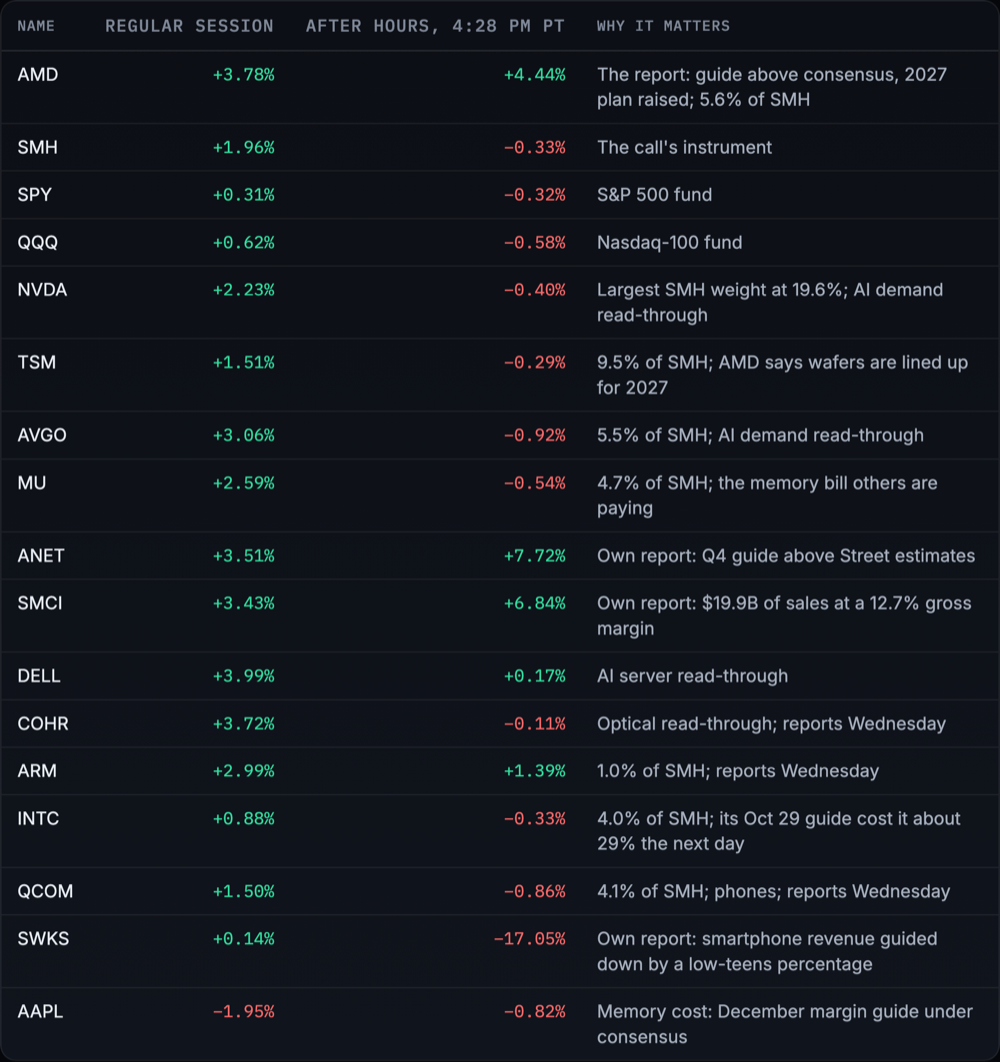
After-hours change is from the regular close. After hours at 4:28 PM PT: SPY −0.32% and QQQ −0.58% from the regular close. SMH weights are as of Oct 30.
Our own board shows how orderly the rotation has been. On Oct 5, 32.3% of the 625 stocks we track closed above their 50-day average. At Tuesday's close it was 60.6%, while SMH lost 18.2% and QQQ lost 9.4% over the same stretch and the equal-weight RSP gained 3.8%. Only 7 of our 31 chip names sit above that line, against 63% of the other 594. We see no forced selling in it, with HYG 1.2% under its 50-day and VIX closing under 21.
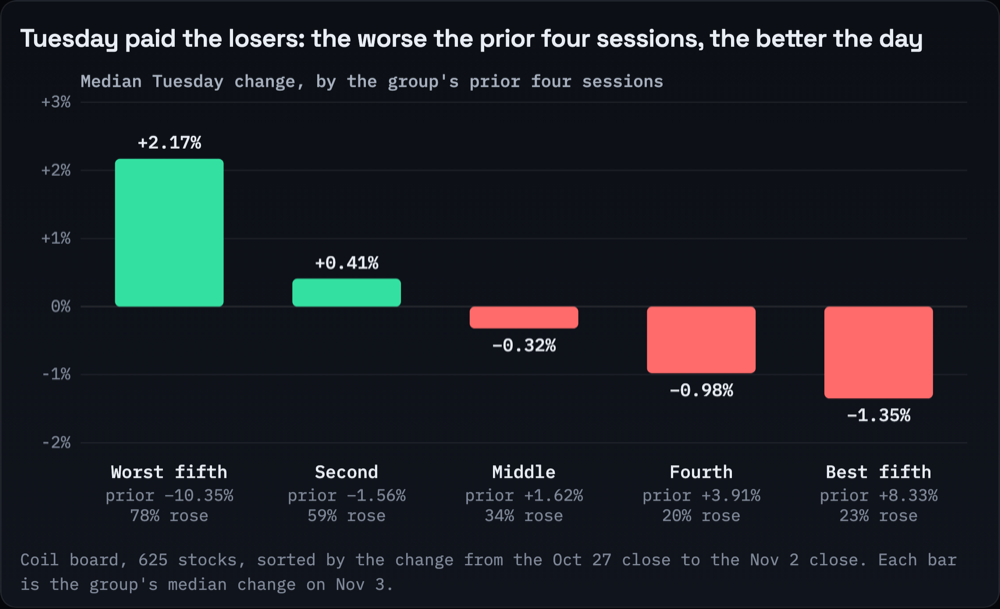
That changes how we read Tuesday's regular session, the part most people will call the turn. We sorted the 625 stocks by their move over the prior four sessions, and the worse a stock had done, the better its Tuesday (correlation −0.46). The median stock fell 0.32% and only 38% beat SPY. Twenty-four of our 31 chip names sat in the worst fifth, and with chips removed that fifth still gained a median 2.09%. So the group's bounce looks like the same reversal that lifted recent losers everywhere, paid for by staples and materials a day after XLP's highest close in 65 sessions.
We paid up on the wrong day

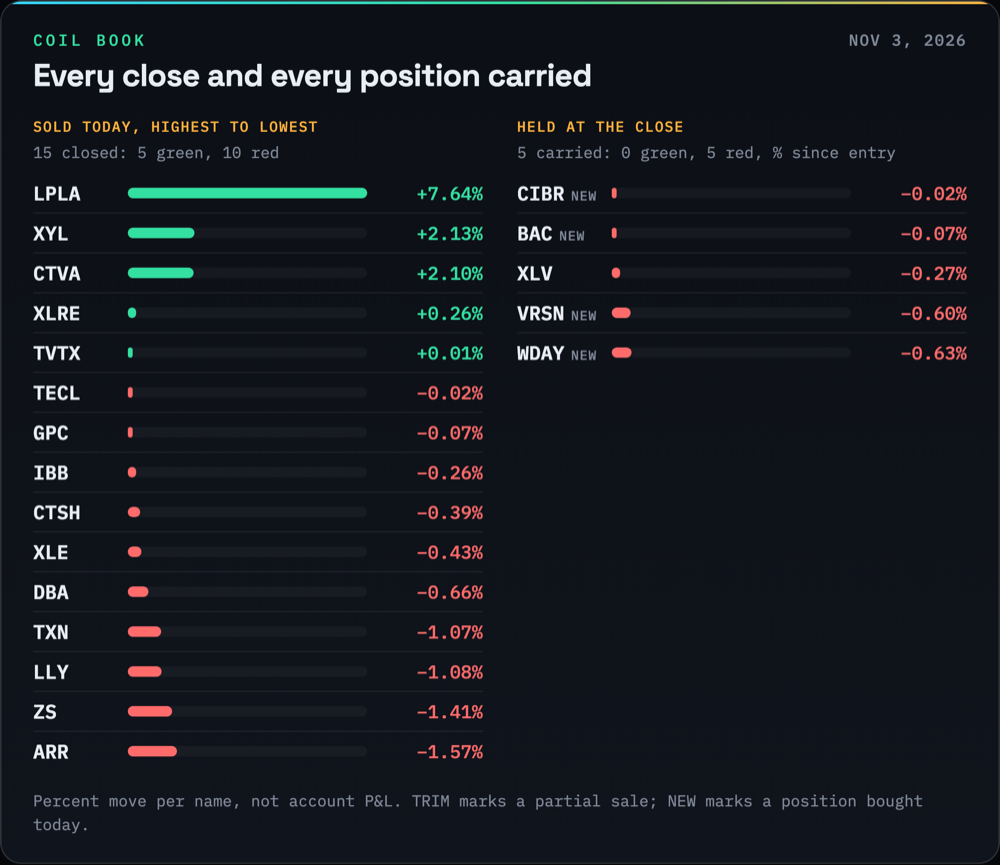
We sold Xylem at 95.72 to pay for Lilly at 1,433.64, and that was the wrong trade. The sale record calls Xylem our weakest holding, sold to fund the purchase. Lilly was 17% over its 50-day with a daily RSI of 76, while stocks above that line were losing ground. We sold it 85 minutes later at 1,418.14 because it was weak and its sector was lagging, a loss of 1.08% of the position. Tuesday's closes were 96.26 for Xylem and 1,409.28 for Lilly.
On a day that paid laggards we kept buying strength. We took Texas Instruments at 316.52, 4.8% above Monday's close, and exited at 313.12 because it was down about 1% while chips rallied, with AMD's report ahead. We took Zscaler 10% over its 50-day and left 65 minutes later for Workday because it was down about 1% while the software group was up, and it closed 0.9% above our sale.
What worked was the reverse. On Oct 30, the day SMH lost 7%, we took LPL Financial, Xylem and Corteva, each under its 50-day, and all three closed green. LPL was the largest gain of the day. Our record says we banked it because it was past its target and financials were lagging, and the stock closed within 0.1% of that sale.
Our call: SMH lower by Friday's close
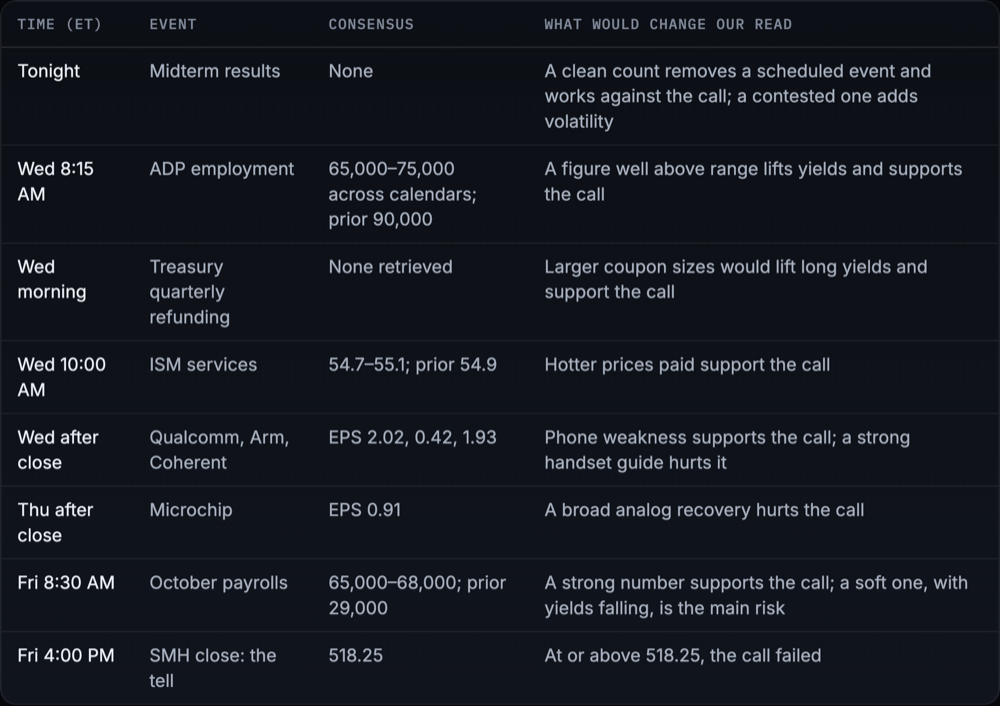
Consensus reads tonight as the all-clear for chips, with AI suppliers up sharply after hours and the Nasdaq-100 fund about 0.0% above Monday's close. We agree on demand. We differ on what SMH has to absorb in three sessions: margins mixing lower, a rising memory bill, two chip reports on Wednesday that lean toward phones, and Friday payrolls that a divided Fed will read closely.
We think SMH closes below its Tuesday close of 518.25 on Friday, November 6. The horizon is Friday's close, and the tell is SMH closing Friday at or above 518.25. Tonight's report made this harder: the after-hours gain already uses about -5% of the 4.6% move the Friday straddle priced at the close.
Two things can make us wrong. The 2027 numbers are real and estimates have not moved yet, so a group this far under its 50-day, with AAII bears at 41.4% against a 31.5% average, can rise on revisions alone from a price already about -0.3% above our line. Monday's close also sat about 1% above the 503.63 low from late July, a level the market may defend.
The second is macro. Payrolls are expected near 65,000-68,000 after 29,000, and a soft number would pull yields lower, ease the funding worry we lean on and break this call.
None of our five holdings is a chip maker or chip fund, and we hold no hedge; the book is long other groups.

1 call open, 0 graded, Nov 3 to Nov 3.
What's next
The full record is at coil.trade/results.
Not advice.
COIL CLOSE is impersonal market commentary. It states a dated view of a market instrument, graded against its stated test, and is not investment advice, a recommendation or an instruction to trade, and is not tailored to anyone’s circumstances. Figures and prices are as of the time stated above.